

Return to sport after ACL surgery is one of the biggest milestones in your rehab. It is also one of the stages where many athletes feel the least certain.
You may have worked hard in the gym. Your knee might feel stronger. You may be running again. You may even be doing some jumping, hopping and change-of-direction drills. But there is still a big difference between feeling good in the gym and feeling ready to step back onto the field, court or pitch.
This is where a complete ACL return to sport program matters, and it’s why our ACL Rehab Sydney and Knee Physio program was created.
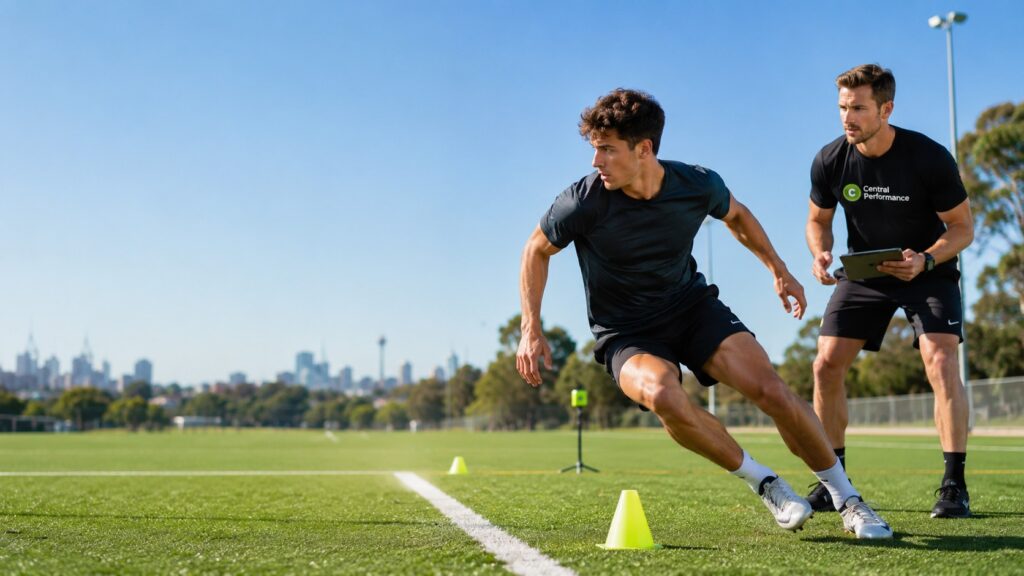
At Central Performance in Surry Hills, our ACL Rehab and Knee Program is designed to help bridge the gap between clinic-based rehab and confident, safe return to sport. That means progressing beyond early ACL exercises and gym strength into running, landing, cutting, agility, reactive drills and supervised field sessions that prepare you for the demands of real sport.
Because sport does not happen on a treatment table.
And for most athletes, the final stage of ACL rehab needs to look a lot more like the sport they are trying to return to.
Return To Sport After ACL Surgery or Injury – Key Takeaways
- Return to sport after ACL surgery should be based on clear criteria, not just time. Strength, swelling, running ability, landing control, cutting, confidence and sport-specific testing all matter.
- Gym strength is essential, but it is not enough on its own. Athletes need to progress from strength work into running, deceleration, change-of-direction, agility and return-to-play drills that match the demands of their sport.
- The Central Performance ACL Rehab Sydney and Knee Physio program in Surry Hills helps bridge the gap between clinic rehab and real sport with strength testing, gym-based rehab, return-to-running progressions and supervised field-based return-to-sport sessions.
When Can You Return to Sport After ACL Surgery? The Quick Answer
Most athletes are not ready to return to sport after ACL surgery based on time alone.
While many people hear timelines such as 9 to 12 months after ACL reconstruction, your actual readiness depends on your strength, knee control, running ability, landing mechanics, change-of-direction capacity, confidence, symptoms, swelling response and the demands of your sport.
A safe return to sport after ACL surgery usually needs:
- Good knee range of motion
- Minimal or no swelling
- Strong quadriceps, hamstrings, calves and glutes
- Good single-leg strength and control
- Successful running progression
- Confident jumping and landing
- Change-of-direction and deceleration ability
- Sport-specific drills
- Return to sport testing
- A gradual return to modified training, full training and then competition
The important point is this: gym strength is essential, but it is not the final step.
The final step is being able to use that strength safely and confidently in the unpredictable, faster and more demanding environment of sport.
Why Gym Strength Matters After ACL Surgery
Gym-based strength training is a major part of ACL rehab. After ACL injury and surgery, many athletes lose significant strength in the quadriceps and surrounding muscles. This can affect walking, stairs, running, jumping, landing, squatting, sprinting and changing direction.
A good strength program helps rebuild the capacity of the knee and the rest of the body so you can tolerate higher loads again. This usually includes progressive work for:
- Quadriceps strength
- Hamstring strength
- Glute strength
- Calf strength
- Hip and trunk control
- Single-leg strength
- Jumping and landing capacity
- Power development
Strength training is one of the foundations of the Central Performance ACL Rehab and Knee Physio program because it gives your knee the physical capacity it needs to handle sport.
But strength by itself does not automatically mean you are ready to play. You also need to know whether you can use that strength well when you are moving quickly, reacting to what is happening around you, and dealing with the fatigue and pressure of training or competition.
That is where many ACL rehab programs fall short.
Why Gym Strength Alone Is Not Enough
The gym is controlled. Sport is not.
In the gym, your feet are usually placed exactly where you want them. You know what exercise is coming next. You control the speed. You control the load. You get time to set up properly.
In sport, everything changes quickly.
You may need to sprint, stop, cut, turn, land, sidestep, chase, avoid contact, react to another player, jump under pressure or change direction when you are tired. That is a completely different demand, and this is why an athlete can look strong in the gym but still feel unsure when they return to the field.
Common things we hear from athletes at this stage include:
- “My knee feels strong, but I still don’t trust it.”
- “I’m fine running straight, but cutting still feels awkward.”
- “I’m nervous when I have to land or change direction.”
- “I don’t know if I’m ready for full training.”
- “I’ve done the exercises, but I haven’t really tested it in a sport setting.”
- “I feel like there’s a big jump from physio to team training.”
That gap is real, and it is exactly why the ACL and knee rehab program includes supervised field sessions as part of the return to training and return to play process.
The Missing Stage In Many ACL Rehab Programs
Many ACL rehab programs do a good job in the early stages. They help settle pain and swelling, restore range of motion, rebuild walking, improve early strength and progress into gym-based exercise. But the later stages often become less clear.
The athlete may be told to “start running”, “try some agility” or “ease back into training” without enough structure, testing or sport-specific preparation. This can leave a big gap between rehab and performance.
That gap matters because returning to sport after ACL surgery is not just about whether the graft has healed. It is about whether the whole athlete is ready. That includes the knee, the rest of the body, the nervous system, the athlete’s movement habits and their confidence.
A complete return to sport pathway should prepare you for the actual movements your sport requires. For field and court athletes, this usually means:
- Acceleration
- Deceleration
- Sprinting
- Curved running
- Side-stepping
- Cutting
- Pivoting
- Jumping
- Landing
- Reactive movement
- Defensive and attacking patterns
- Sport-specific drills
- Fatigue-based movement quality
- Progressive return to team training
These qualities are hard to develop properly if rehab only stays inside the clinic.
Why Field Sessions Are So Valuable After ACL Surgery
Field sessions are one of the most important parts of the Central Performance Knee Program. They allow us to take your rehab out of the gym and into the environment where you actually need to perform. This is not common in standard physiotherapy rehab, but it can be a massive help for athletes returning to sport after ACL injury or surgery.
Field sessions help bridge the gap between being strong and being sport-ready. They allow your physio or rehab coach to see how you move when the task becomes faster, more open and more realistic. They also give you the chance to practise the movements that often create the most hesitation after ACL surgery, including cutting, landing, sprinting, stopping and changing direction. This is important for physical preparation, and it is also critical for regaining confidence in your knee.
Many athletes do not just need to get stronger. They need repeated, well-coached exposure to the exact movements they are worried about. Not all at once. Not randomly. Not by being thrown straight back into team training. But in a structured way that builds from simple drills to more complex, sport-specific tasks.
What Happens In An ACL Rehab Field Session?
A field session is not just a fitness session. It is a structured return to sport session designed around your stage of rehab, your sport, your current ability and the movements you need to rebuild.
Depending on your stage, a field session may include:
- Running mechanics
- Acceleration drills
- Deceleration drills
- Change-of-direction drills
- Cutting and sidestepping progressions
- Landing and re-acceleration drills
- Low-level agility patterns
- Reactive movement drills
- Sport-specific movement patterns
- Confidence-building exposure to higher-speed tasks
- Assessment of movement quality under more realistic conditions
For example, an early field session may focus on controlled running mechanics, planned deceleration and simple directional changes.
A later-stage session may include sharper cutting, reactive drills, sport-specific patterns and higher-speed movements that look much closer to training.
The goal is not to rush you back. The goal is to make the return feel more predictable, more measurable and more controlled. That way, when you do return to modified team training, it is not the first time your knee has experienced those demands.
Return To Training Versus Return To Play
One of the biggest mistakes in ACL rehab is treating return to training and return to play as the same thing. They are not the same.
Return to running comes first.
Then return to controlled drills.
Then return to modified training.
Then return to full training.
Then return to competition.
Each stage has different demands. Returning to modified team training might mean joining warm-ups, completing non-contact drills or participating in controlled skills work. Returning to full training means tolerating the speed, fatigue, unpredictability and contact demands of normal sessions. Returning to play means being ready for competition, where the intensity is usually higher again.
The Central Performance ACL Rehab Sydney and Knee Physio program is built around this staged progression. We help you understand what stage you are in, what needs to improve, and what needs to happen before the next step.
How Do You Know If You Are Ready To Return To Sport?
A good return to sport decision should never be based only on time since surgery. Time matters, but it is only one part of the picture. Before returning to sport after ACL surgery, your rehab team should consider:
- Your symptoms
- Your swelling response
- Your knee range of motion
- Your strength testing results
- Your hopping and landing ability
- Your running progression
- Your change-of-direction ability
- Your confidence
- Your sport demands
- Your training history
- Your surgeon’s guidance where relevant
- Your ability to tolerate repeated training loads
VALD Performance Testing For ACL Return To Sport

One of the biggest challenges in ACL rehab is knowing when your knee is actually ready for the next step. Not just when it feels better. Not just when enough time has passed. But when your strength, control, power and landing ability are ready for running, jumping, cutting, training or sport.
At Central Performance, we use VALD ForceDecks and DynaMo hand-held dynamometry to give us objective data during ACL rehab. This helps us make better return-to-sport decisions because we are not relying on guesswork alone.
VALD ForceDecks measure how you produce and absorb force during movements such as squats, jumps and landings. This can show whether you are still favouring one side, avoiding load through the operated leg, or lacking the ability to absorb force confidently.
DynaMo hand-held dynamometry helps us measure specific muscle strength, including quadriceps, hamstrings and hip strength. This is especially useful after ACL surgery because strength deficits can still be present even when your knee feels good and your exercises look strong.
This testing helps us answer important questions:
- Is your operated leg strong enough?
- Are you loading both sides evenly?
- Can you absorb force safely when landing?
- Are you ready to progress to running, jumping or field drills?
- Do you need more strength work before returning to training?
- Is your rehab moving in the right direction?
For athletes, this provides clarity and confidence. You can see your progress, understand what still needs work, and know why your program is being progressed.
Instead of returning to sport because “it has been long enough”, we can make decisions based on your symptoms, movement quality, strength testing and performance data.
This is a key part of the Central Performance Knee Program. We combine VALD performance testing with gym-based rehab, running progressions and field-based return-to-sport sessions to help you return with more confidence, more control and a clearer plan.
At Central Performance, we use objective testing wherever possible because it gives you much clearer information than guessing. Testing helps answer questions like:
- Is your operated leg strong enough compared to the other side?
- Can you produce and absorb force well?
- Can you land with good control?
- Can you decelerate safely?
- Can you change direction without hesitation or poor mechanics?
- Can you tolerate sport-like loads without swelling or pain?
This gives your return to sport plan more structure. It also helps identify the exact areas that still need work.
Why Confidence Matters In ACL Rehab
Confidence is not just a mindset issue. After ACL surgery, it is very normal to feel hesitant when you return to faster or more demanding movement. This can happen even when your knee feels physically strong.
Your brain is trying to protect you. It remembers the injury. It knows that the knee has been through surgery and months of rehab. So when you ask it to sprint, cut, land or react under pressure again, it may hold you back. This can show up as:
- Hesitation when changing direction
- Avoiding the operated leg
- Landing stiffly
- Slowing down before cutting
- Feeling anxious before training
- Not trusting the knee in contact or unpredictable situations
- Feeling physically ready but mentally unsure
The answer is not to ignore that fear. The answer is to rebuild confidence through progressive exposure. That means practising the right drills at the right level, with the right coaching, and progressing them as your knee and confidence improve.
This is one of the biggest benefits of field-based ACL rehab.
You get to rebuild trust in your knee before you are back in the full pressure of team training or competition.
6 Common Mistakes When Returning To Sport After ACL Surgery
1. Returning Based On Time Alone
A common mistake is assuming that reaching 9 or 12 months means you are automatically ready to play. Some athletes may be ready around that stage. Others may need longer. Some may have missed key strength, running or change-of-direction milestones along the way. Your return should be based on criteria, not just the calendar.
2. Skipping Proper Strength Testing
Feeling strong is not the same as being strong enough for sport. Objective testing can help identify strength deficits that are not obvious in day-to-day life or basic gym exercises. This is especially important for quadriceps strength, which is often difficult to fully restore after ACL surgery.
3. Going From Straight-Line Running Straight Into Team Training
Straight-line running is an important milestone, but it does not prepare you for everything sport requires. Most field and court sports involve rapid acceleration, deceleration, lateral movement, cutting, turning, jumping, landing and reacting. These need to be progressed gradually.
4. Not Practising Deceleration
A lot of athletes focus on running faster, jumping higher or cutting harder. But slowing down well is just as important. Deceleration places high demands on the knee and is a key part of safe change of direction. If you cannot brake well, cutting and pivoting become much harder to control.
5. Doing Agility Drills Without A Clear Plan
Agility work should not just be random cones and ladders. Good agility progressions should match your stage of rehab and the demands of your sport. They should move from planned and controlled drills through to faster, more reactive and more sport-specific movements.
6. Ignoring Swelling After Training
Swelling after a session is useful information. It may mean the knee has been overloaded or is not yet ready for that level of work. A good return to sport plan monitors how your knee responds during the session, later that day and the next day.
What Makes The Central Performance ACL Rehab and Knee Physio Program Different?
The Central Performance ACL Rehab Sydney and Knee Physio program is designed for active people and athletes who want more than basic rehab. It is for people recovering from ACL injuries, ACL reconstruction, conservative ACL management and other sports knee injuries, including meniscal injuries.
The goal is not just to get your knee feeling better. The goal is to help you rebuild strength, movement quality, confidence and performance so you can return to training and sport with a clear plan. The program brings together:
- Sports knee physiotherapy
- Progressive strength and conditioning
- Objective testing
- Running progressions
- Jumping and landing progressions
- Change-of-direction and agility work
- Field-based return to sport sessions
- Return to training and return to play planning
- Education and support throughout the process
Central Performance is located in Surry Hills, close to Central Station, making it easy to access from Sydney CBD, Redfern, Darlinghurst, Paddington, Alexandria, Pyrmont, Waterloo, Moore Park and surrounding suburbs.
For many athletes, this matters because ACL rehab is not a one-session fix. It is a process. Having the right facilities, the right team and the right location makes it much easier to stay consistent.
Why Choose Central Performance For ACL Return To Sport Rehab?
There are many physios who can help in the early stages after ACL surgery. But the later stages need a different level of planning and progression.
At Central Performance, our approach is built around the full journey from injury to performance. That means we can help with early rehab, gym-based strength, running progressions, return to sport testing and field-based training.
Everything is designed to connect. You are not left trying to piece together advice from different places or guessing when to take the next step.
Our team regularly works with active people, runners and athletes who want to return to a high level of training. We understand that the goal is not simply to walk without pain or complete a basic exercise program. The goal is to run, cut, land, train, compete and trust your body again. That is the difference.
Working With An Experienced Physio In ACL Rehab Really Matters
Your first step to a strong knee is simple — book an assessment with our knee physio, Joden Wilson. As well as being a Central Performance physio Joden also heads up the South Sydney Rabbitohs pathways long-term rehab program, managing athletes through post-surgical ACL/knee rehabilitation, return to running, and field-based performance progressions. This experience allows him to bring elite-level rehab principles and return-to-sport expertise into our ACL/knee rehab program.

Joden Wilson
APA Physiotherapist
Head of Long-Term Rehab – South Sydney Rabbitohs Pathways Program
Joden is the developer and manager of the Central Performance ACL Rehab Sydney and Knee Physio Program. As well as working clinically at Central Performance, his role with the South Sydney Rabbitoh’s has him managing elite-level athletes through post-surgical ACL/knee rehabilitation, return to running, and field-based performance progressions. This experience allows him to bring elite-level rehab principles and return-to-sport expertise into our ACL/knee rehab program. He loves working with athletes of all abilities, from recreational to elite, to help them safely and confidently return to sport.
Click below for more information or to book your first knee physio session
How This Fits With The Rest Of Your ACL Rehab
If you are earlier in your ACL journey, or are looking for an overview of ACL recovery, you may want to start with our guide on ACL Rehab Sydney and Knee Physio Program
If running is your next milestone, our guide on return to running after ACL injury or surgery explains how to approach that stage safely.
For athletes who also want to improve running mechanics and running capacity, our Central Performance Running Centre and RunRight Running Coaching services can be useful parts of the bigger picture.
And because strength is such a key part of long-term knee health and performance, our strength and conditioning for runners service is also highly relevant for many athletes returning after ACL injury.
When Should You Start Field-Based ACL Rehab?
Field-based rehab does not happen at the start of your ACL recovery. It needs to be introduced at the right time, once you have built a solid foundation of stability and strength. Before starting field sessions, you will usually need:
- Adequate strength
- Good knee range of motion
- Good control with basic landing and hopping tasks
- The ability to tolerate running progressions without increased pain or swelling
- A clear understanding of your current rehab stage
- A plan for how field drills will progress into modified training and full training
The exact timing depends on your surgery, your sport, your strength, your symptoms, your testing results and your overall recovery. For some athletes, field sessions may start with simple running and deceleration drills. For others, especially later in rehab, they may include more advanced cutting, agility and sport-specific work. The key is that it should be staged. You do not need to jump straight from the gym into full-speed sport.
Who Is The Central Performance ACL Rehab and Knee Physio Program For?
The Knee Program is designed for people with sports knee injuries who want a clear, structured pathway back to training and performance. It is ideal if you:
- Have had ACL reconstruction
- Have ruptured your ACL and are considering conservative management
- Are preparing for ACL surgery and want prehab
- Are returning to running after ACL injury
- Are returning to football, soccer, netball, basketball, rugby, AFL, touch football or another field or court sport
- Have a meniscal injury and want to return to training safely
- Feel strong in the gym but not confident on the field
- Are unsure whether you are ready for team training
- Want objective testing rather than guesswork
- Need a sports knee physio near Surry Hills, Sydney CBD, Redfern, Darlinghurst, Paddington, Alexandria or Pyrmont
The Real Goal: Returning With Confidence
The final stage of ACL rehab is not just about getting clearance. It is about feeling ready.
Ready to accelerate and stop.
Ready to cut and pivot.
Ready to land and react.
Ready to train. Ready to play.
That confidence does not come from one test or appointment, or from controlled exercises in the gym. It comes from a structured process where each step makes sense and each progression prepares you for the next one.
That is what the Central Performance ACL Rehab and Knee Physio Program is designed to provide: A clear pathway from rehab to running, training and sport.
Book An ACL Rehab and Return To Sport Assessment In Surry Hills
If you have had ACL surgery and you are not sure whether you are ready to return to sport, book an assessment with the Central Performance Knee Program physio team. We will help you understand where you are now, what still needs work, and what the next stage of your return to sport plan should look like.
Central Performance is located in Surry Hills, close to Central Station and easily accessible from Sydney CBD, Redfern, Darlinghurst, Paddington, Alexandria, Pyrmont and surrounding suburbs.
Start Your ACL Recovery Pathway Today
If you have had an ACL injury, whether you have had surgery or are managing it conservatively (i.e. without surgery), we can answer all of your questions and get you started on the road to recovery. The Central Performance ACL Rehab Sydney and Knee Physio Program is also ideal if you have had other types of knee injuries and want to return to training and play as safely and confidently as possible, for example meniscus injuries or other ligament sprains like MCL, LCL or PCL. Click below for more info of to book your first appointment and get started.
Written by Joden Wilson — ACL Rehab Physio and Knee Physiotherapist · Updated August 2026
FAQs About Return To Sport After ACL Surgery
How long does it take to return to sport after ACL surgery?
Many athletes aim to return to sport around 9 to 12 months after ACL surgery, but the timeline varies. Your readiness should be based on strength, movement quality, running ability, confidence, sport-specific testing and how your knee responds to training loads, not time alone.
Why do I feel strong in the gym but not confident playing sport?
This is very common after ACL surgery. The gym is controlled, while sport involves speed, fatigue, reaction, contact, cutting, landing and unpredictable movement. You may need more progressive exposure to sport-specific drills before you feel confident again.
What are ACL field sessions?
ACL field sessions are supervised rehab sessions completed on a field or open training space. They focus on running, acceleration, deceleration, change of direction, cutting, agility, landing and sport-specific drills. They help bridge the gap between gym rehab and return to play.
Do I need return to sport testing after ACL surgery?
Return to sport testing is strongly recommended because it gives clearer information about your strength, control, hopping, landing and readiness for higher-level activity. It helps identify what still needs work before you return to full training or competition.
Can I return to sport if my knee still swells after training?
Ongoing swelling after training suggests your knee may not be tolerating the current load. You should have this assessed before progressing. Swelling is useful feedback and may mean your program needs to be modified.
Is running enough to prepare for sport after ACL surgery?
No. Running is an important milestone, but most sports require much more than straight-line running. You also need to prepare for sprinting, stopping, cutting, turning, landing, reacting and coping with fatigue.
When should I see a sports knee physio after ACL surgery?
You should see a sports knee physio if you are unsure what stage of rehab you are in, if your knee is swelling or painful, if you are struggling to rebuild strength, if you are nervous about running or cutting, or if you need a structured return to sport plan.
Where can I do ACL return to sport rehab in Sydney?
The Central Performance Knee Program in Surry Hills provides ACL return to sport rehab for athletes across Sydney, including Sydney CBD, Redfern, Darlinghurst, Paddington, Alexandria, Pyrmont and nearby suburbs. The program includes physiotherapy, strength and conditioning, objective testing and field-based return to sport sessions.
