


Shin splints vs stress fracture is one of the most important distinctions in running injuries, because the two can feel similar early on but need very different management. Shin splints (medial tibial stress syndrome) usually cause a diffuse ache along the inner shin that eases as you warm up. A stress fracture usually causes sharp pain in one small spot that gets worse the longer you run, and often lingers at rest or at night.
Both sit on the same spectrum of bone stress, which is why shin splints that are ignored can progress into a stress reaction and then a stress fracture. Picture three weeks off running, the first 10 km back, and the same spot flares again. That pattern is a sign the bone hasn’t caught up with the load.
In this guide, we explain how to tell the two apart, which simple checks are useful, when you need a scan, how long each takes to heal, and why shin splints keep coming back for some runners.
Key takeaways
- Shin splints usually cause diffuse pain along the inner shin. A stress fracture usually causes focal pain in one spot that you can point to with a finger.
- Shin splints, stress reactions and stress fractures sit on a continuum of bone stress. Catching it early usually means a shorter time away from running.
- Pain on hopping, pain at rest or at night, and sharp tenderness on the bone are reasons to stop running and get assessed.
- X-rays often look normal in the early weeks. MRI is the most sensitive scan when imaging is needed.
- Recurring shin pain is often linked to training load, strength, sleep and under-fuelling (RED-S), not just footwear or running technique.
Shin splints vs stress fracture: the short answer
The simplest way to think about it is the size of the painful area and how it behaves with running.
- Shin splints: a dull ache spread along the lower two-thirds of the inner shin, often worse at the start of a run, easing as you warm up, then returning afterwards.
- Stress fracture: sharp, localised pain in one spot on the bone that gets worse the more you run, and may hurt when walking, at rest or at night.
Shin splints are increasingly understood as an early bone stress problem rather than just a muscle issue, and they can progress if the load keeps outpacing your bone’s ability to recover. If you’re unsure which one you have, treat it as the more serious option until you’ve been assessed. For a broader look at every cause of shin pain, see our guide to shin pain when running.
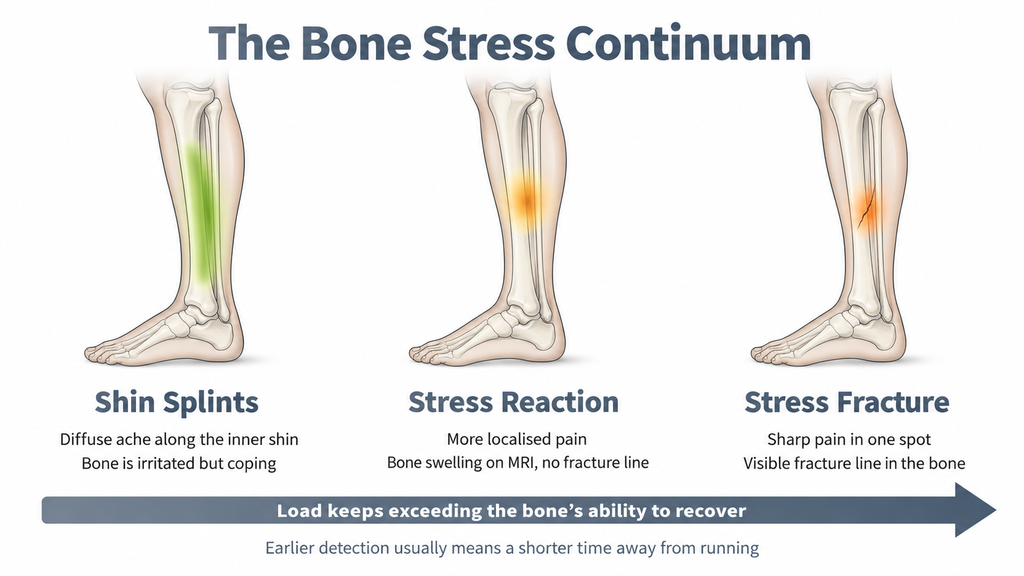
The bone stress continuum: shin splints → stress reaction → stress fracture
Bone is constantly remodelling. Every run creates tiny amounts of damage, and between runs your body repairs it and lays down stronger bone. A bone stress injury develops when the damage builds faster than the repair (Warden et al., 2014). It usually happens gradually, with repeated runs rather than one big session.
Clinicians often describe this as a continuum:
- Shin splints (medial tibial stress syndrome): irritation of the bone and the tissue covering it along the inner shin. Pain is diffuse and the bone is coping, but only just.
- Stress reaction: swelling within the bone on MRI, with no fracture line. Pain is more localised and running becomes harder to tolerate.
- Stress fracture: a visible fracture line in the bone. Pain is focal and sharp, and running usually isn’t possible without pain.
MRI grading systems for tibial bone stress injuries (Fredericson et al., 1995) are built on this idea, with higher grades generally linked to longer recovery. The shin is the most common site in runners, but bone stress can also affect the foot, heel, hip and thigh. For example, navicular bone stress injuries in the mid-foot are a high-risk site that needs careful management.
Low-risk vs high-risk sites
Not all stress fractures behave the same way. Most shin stress fractures in runners occur on the inner (posteromedial) border of the tibia and are considered low risk because they usually heal well with relative rest. Stress fractures on the front (anterior) border of the tibia, and at sites like the navicular or the femoral neck, are considered high risk. They’re more prone to delayed healing or complete fracture and usually need specialist input and a longer, more cautious rehab.
Shin splints or stress fracture? Symptoms side by side
Typical shin splints symptoms
- Diffuse ache along the lower inner shin, often over 5 cm or more
- Tender to press along a strip of the bone, rather than one spot
- Pain early in a run that may ease as you warm up, then returns afterwards
- Often affects both legs
- Usually settles with rest and doesn’t disturb sleep
Typical stress fracture symptoms
- Sharp, localised pain you can point to with one finger
- Pain that builds the further you run, and may force you to stop
- Pain when walking, on stairs or at rest, and sometimes at night
- Pain when hopping on the affected leg
- Sometimes local swelling or thickening over the bone
Symptoms overlap, especially in the stress reaction stage. That’s why a history of how the pain started and changed, combined with a hands-on assessment, matters more than any single symptom.
Simple warning signs and self-checks
These checks can help you decide whether to get assessed. They aren’t diagnostic, and they’re not a reason to keep testing a sore leg.
1. Shin palpation
Press firmly along the inside edge of your shin bone, roughly two-thirds of the way down, on both legs. Tenderness spread over several centimetres fits more with shin splints. A single, very sharp spot on the bone is more concerning.
2. Shin oedema check
Press and hold the same area for about five seconds. If a dent stays in the skin after you let go (pitting oedema), the area is under strain. Research in military recruits (Newman et al., 2012) found that people who were sore on palpation and had shin oedema were considerably more likely to develop shin splints.
3. Single-leg hop
If walking is comfortable, try a few gentle hops on the affected leg. Sharp, localised pain on hopping is a common feature of bone stress injuries. If it hurts, stop, don’t repeat it, and get assessed before you run again.
Red flags that need prompt assessment
- Pain at rest or pain that wakes you at night
- Limping, or pain with normal walking
- Pain on the front of the shin, in the top of the foot, or deep in the groin or hip
- Pain that hasn’t eased after one to two weeks of reduced running
You may have heard of the tuning fork test for stress fractures. It isn’t reliable enough to rule a fracture in or out, so we don’t recommend relying on it.
Do you need a scan for shin pain?
Not always. Many cases of shin splints can be diagnosed clinically from your history and examination. Imaging becomes more important when a stress reaction or fracture is suspected, or when the answer will change how you’re managed.
A scan is more likely to be useful if:
- You have focal bony tenderness or pain on hopping
- The pain is at a high-risk site, such as the front of the shin, the navicular or the hip
- Symptoms aren’t improving despite reducing your running
- You’ve had previous bone stress injuries or there are signs of RED-S
- You have a key race or competition coming up and need a clear timeline
X-ray vs MRI
X-rays are often normal in the first few weeks of a stress fracture, because the healing response that shows up on X-ray takes time to develop. A normal X-ray doesn’t rule out a bone stress injury. MRI is the most sensitive test and can show bone swelling before a fracture line appears, which is why it’s usually preferred when imaging is needed. It also involves no radiation.
The referral pathway
No GP referral is needed to see a physio. After assessing you, our physios can refer you for imaging where appropriate. When MRI, blood tests or specialist input are needed, we work with your GP or a sports and exercise physician. For more complex cases, care may also involve a sports dietitian, an endocrinologist, or an orthopaedic surgeon for high-risk fractures, with your physio coordinating your rehab and return to running.
Treatment and healing time for each
Every case is different, so treat these time-frames as general ranges rather than promises. Your timeline depends on the site, grade, how early it was caught, and your overall health and fuelling.
Shin splints treatment
Shin splints treatment is mainly about adjusting load, not complete rest. That usually means reducing running volume and intensity to a level that doesn’t aggravate symptoms, cross-training to maintain fitness, and building calf, soleus and hip strength. Many runners improve over several weeks, though longer-standing cases can take a few months.
Stress reaction and stress fracture treatment
Low-risk tibial stress fractures generally need a period off running, with walking and cross-training as tolerated. Some people need a moon boot or crutches for a short time if walking is painful. Many runners return to running somewhere in the range of six to twelve weeks, with lower-grade stress reactions often quicker and higher-grade or high-risk fractures taking longer (Nattiv et al., 2013).
Return to running is usually staged once you’re pain-free with walking, there’s no tenderness on the bone, and you can hop without pain. It typically starts with short run-walk sessions on alternate days and builds gradually over several weeks. Our guide to returning to running after injury explains this process step by step.
Why won’t my shin splints go away?
If your shin pain keeps returning, it’s usually because the underlying cause hasn’t changed. Common reasons include:
- Training spikes: sudden jumps in volume, speed work, hills or a new race block.
- Returning too quickly: resting until the pain settles, then going straight back to previous mileage.
- Limited strength: particularly the calf and soleus, which help absorb load through the shin.
- Technique and environment: over-striding, a sudden change in shoes or surface, or lots of running on cambered roads.
- Recovery: poor sleep, high work stress and alcohol can all reduce bone recovery between runs.
- Low calcium or vitamin D, which are important for bone health.
Under-fuelling and RED-S
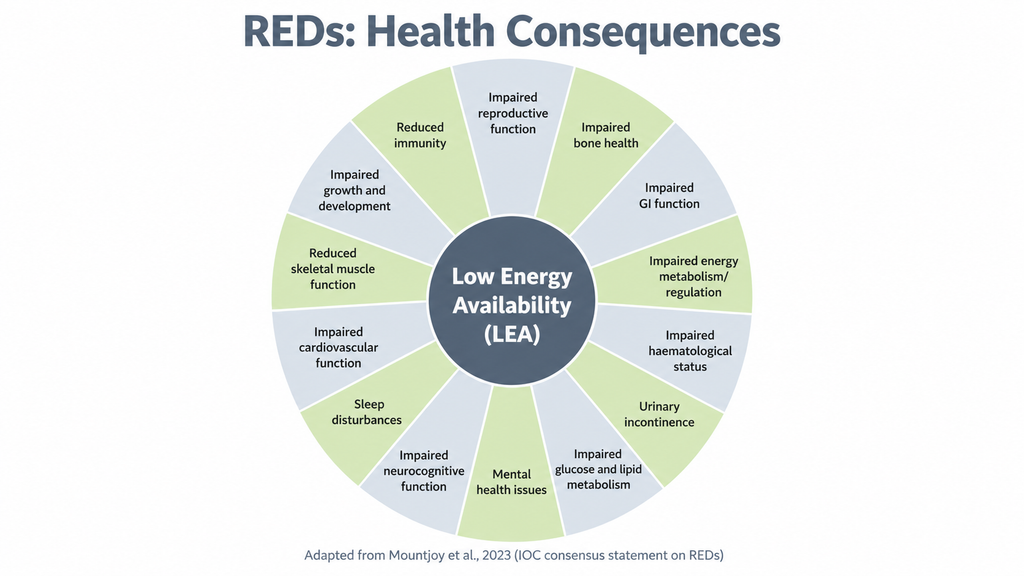
Relative Energy Deficiency in Sport (RED-S) happens when you’re not eating enough to cover the energy demands of training and normal body function. It affects hormones, bone health and recovery, and is a well-recognised risk factor for bone stress injuries in both women and men (Mountjoy et al., 2023). Warning signs include:
- Missed, irregular or absent periods
- Frequent illness, ongoing fatigue or a plateau in performance
- Low libido, or low energy and mood
- Repeated bone stress injuries, especially in the hip, pelvis or femur
If RED-S is suspected, your care may involve your GP, a sports dietitian and sometimes a bone density scan. Addressing fuelling is often the difference between a one-off injury and a recurring one.
A running gait analysis and a structured strength and conditioning program for runners can help address the training and technique side.
Not just runners
The same principles apply to anyone whose bones take repeated impact. We see bone stress injuries in netball, football and touch footy players in pre-season, dancers, military recruits, hikers doing big walking days, and people who suddenly ramp up their step count. The pattern is usually the same: a rapid increase in load without enough time, fuel or recovery for the bone to adapt.
Shin splints vs stress fracture: signs it’s time to get help
Book in with a physio if you notice any of the following:
- Shin pain that’s getting worse rather than better
- Pain that you can pinpoint to one spot on the bone
- Pain on hopping, walking or stairs
- Pain at rest or at night
- Swelling or thickening over the shin
- Pain on the front of the shin, in the top of the foot, or deep in the hip or groin
- A previous bone stress injury, or signs of under-fuelling
- Shin pain that keeps coming back every time you build your running
Early assessment usually means a shorter, simpler recovery. It also gives you a clear plan for getting back to running with less chance of it happening again.
Get Expert Help – Running Physio for Shin Pain in Sydney
If you’re dealing with shin pain right now, the most important step is getting on the right plan early.
At Central Performance, we focus on:
- A thorough assessment to tell shin splints apart from a bone stress injury
- Referral for imaging when it’s needed, coordinated with your GP or sports physician
- A staged, structured return-to-running plan
- Strength, gait and training load changes to help reduce the chance of it coming back
You’ll work with experienced physios who understand both injury management and performance — so you’re not just recovering, you’re progressing.
Next step: Book an appointment with our running physio team in Surry Hills and start your recovery with a clear plan.
You can book online or ask a question by clicking below, or call our friendly reception team on 9280 2322.
Relieve. Restore. Elevate.
Related reading
- Shin pain when running: causes, treatment and when to worry
- Bone stress injuries: you need to know these key signs
- Navicular bone stress injuries in runners
- How to return to running after injury
- Running physio in Sydney
Shin splints vs stress fracture – FAQs
How do I know if it’s shin splints or a stress fracture?
Shin splints usually cause a diffuse ache along the inner shin that may ease as you warm up. A stress fracture usually causes sharp pain in one spot you can point to, which worsens with running and may hurt at rest, at night or when hopping. Because symptoms overlap, a physio assessment is the most reliable way to tell them apart.
Can I run with shin splints?
Sometimes, with modified load. If the pain is mild, diffuse and settles quickly after running, reducing volume and intensity may let you keep running while you build strength. If the pain is sharp, localised, worsening, or present when walking, hopping or at night, stop running and get assessed, as these can be signs of a bone stress injury.
Why won’t my shin splints go away?
Shin splints often persist because the underlying cause hasn’t changed. Common reasons include returning to full mileage too quickly, training spikes, limited calf and soleus strength, poor sleep and under-fuelling (RED-S). Ongoing pain can also mean the problem has progressed to a stress reaction. A physio assessment can identify what’s driving it and guide a structured plan.
How long does a tibial stress fracture take to heal?
It varies with the site and severity. Many runners with a low-risk tibial stress fracture on the inner shin return to running somewhere in the range of six to twelve weeks, followed by a gradual build back to full training. High-risk fractures on the front of the shin usually take longer and may need specialist management.
Do I need an MRI for shin pain?
Not always. Many cases of shin splints are diagnosed from your history and examination. An MRI is more likely to be recommended if you have focal bone tenderness, pain on hopping, pain at a high-risk site, symptoms that aren’t improving, or a history of bone stress injuries. MRI is the most sensitive scan for early bone stress.
Can shin splints turn into a stress fracture?
Yes, they can. Shin splints sit at the mild end of a bone stress continuum. If you keep loading the shin faster than it can recover, the irritation can progress to a stress reaction and then a stress fracture. Reducing load early and building strength gradually helps reduce that risk.
Will a stress fracture show up on an X-ray?
Often not in the early stages. X-rays can look normal for the first few weeks of a stress fracture, because the healing changes visible on X-ray take time to develop. A normal X-ray doesn’t rule out a bone stress injury. If one is suspected, an MRI is usually the preferred test.
What does a stress fracture in the shin feel like?
A shin stress fracture usually feels like a sharp, deep pain in one specific spot on the bone. It tends to build during a run and may force you to stop. As it progresses, it can hurt with walking, on stairs, at rest or at night. The spot is usually very tender to press, and hopping on that leg is often painful.
Written by Mikayla Mestousis — APA Physiotherapist, Certified Running Coach, Pilates Instructor & S&C Coach
