

Pilates for beginners doesn’t need to feel intimidating. If you’ve walked past a studio full of reformers and wondered where you’d even start, the short answer is this: begin at a true beginner level, learn the basics of breathing, trunk control and alignment, and build from there at a pace that suits your body.
Your first session is usually slower and more detailed than people expect. You’ll spend time on how you breathe, how to switch on your deep trunk muscles without bracing, and how the equipment works before anything gets challenging. Mat, reformer and Clinical Pilates can all work well for beginners. The right choice depends on your goals and whether you’re managing pain or an injury.
In this guide, we cover what happens in your first Pilates class, what to wear, how to start safely if something hurts, and how to choose between private sessions and small groups at our Surry Hills studio.
Key takeaways
- Pilates for beginners starts with fundamentals: breathing, trunk control, alignment and learning how the equipment works.
- Reformer Pilates suits beginners when it’s taught at the right level, because the springs can assist you as well as add resistance.
- If you have pain or an injury, Clinical Pilates with a physio assessment is a sensible place to start.
- Wear fitted, comfortable clothing and grip socks. You don’t need to be flexible or particularly fit to begin.
- Many people notice they move with more control and confidence after a few weeks of regular sessions, although everyone progresses differently.
Pilates for beginners: where to start
Pilates is a form of exercise developed by Joseph Pilates in the early 20th century. It focuses on controlled movement, coordinated breathing, trunk strength and mobility. Today it ranges from mat classes using your own body weight through to equipment-based sessions on the reformer, chair, barrel and trapeze table.
Before you book your first Pilates class, it helps to be clear on why you’re starting. Common reasons include:
- General strength and control: you want a structured way to get stronger without heavy lifting.
- Supporting other training: you run, lift or play sport and want better trunk and hip control.
- Returning to exercise: you’ve had time off after an injury, surgery or a busy stretch of life.
- Managing ongoing pain: you have a back, neck or hip that tends to flare and you want to load it sensibly.
Your reason shapes where you start. If you’re pain-free and want general fitness, a beginner-friendly small group class is a good entry point. If pain or a past injury is part of the picture, starting with an assessment means your program is built around what your body needs right now, not what the person on the next reformer is doing.
Mat, reformer or Clinical Pilates: which suits beginners?
All three styles share the same principles. The difference is in the equipment, the level of individual tailoring and who’s delivering the session.
Mat Pilates
Mat Pilates uses your body weight with small props such as a ball, band or foam roller. It’s accessible and easy to keep up at home. The catch for beginners is that there’s no spring assistance, so some exercises can be harder than they look. A roll-up on the mat, for example, often feels tougher than the same movement supported by springs on the reformer.
Reformer Pilates
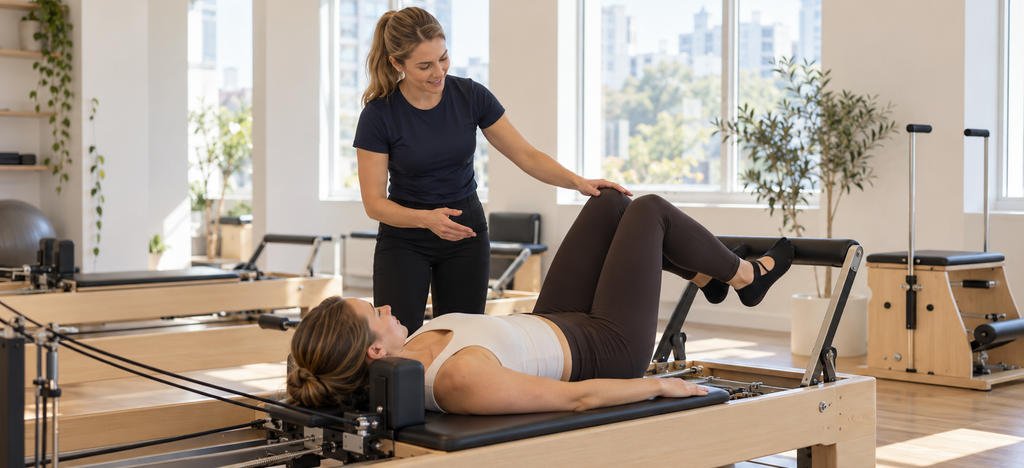
The reformer is a sliding carriage attached to adjustable springs, with a footbar and straps for your hands or feet. Reformer Pilates for beginners works well because the springs can either assist a movement or add resistance, and the carriage gives you instant feedback on how smoothly you’re moving. Where beginners can struggle is in large, fast-paced classes that move on before the basics are in place.
Clinical Pilates
Clinical Pilates is delivered by a physiotherapist. At Central Performance, that’s Mikayla Mestousis or Harry Fry. It starts with a physio assessment, and your program is built around your injury history, symptoms and goals using the reformer, chair, barrel and mat. Because it’s physio-delivered, Clinical Pilates is claimable as physiotherapy with private health extras cover.
Put simply: if you’re pain-free, a beginner-level contemporary class is a reasonable place to start. If you have pain, a past injury or a specific goal, Clinical Pilates gives you a tailored starting point you can progress from.
What happens in your first Pilates session
A good first session is mostly about learning. Expect plenty of explanation, a slower pace and a lot of feedback. Here’s what it usually covers.
Assessment and goal-setting
In a Clinical Pilates initial session, your physio takes a history and looks at how you move. That might include a squat, single-leg balance, bending and rotating through your spine, and any movements that bring on your symptoms. In a small group class, your instructor will ask about injuries, experience and anything they should know before you start.
Breathing
Pilates uses a breathing pattern that expands the rib cage sideways and back, often called lateral breathing. You’ll typically breathe out on the effort of a movement. Don’t overthink it. The main goal early on is simply not to hold your breath when an exercise gets harder.
Finding your core without over-bracing
You’ll learn to gently engage your deep trunk muscles, including the transversus abdominis, pelvic floor and the small muscles along your spine. This is a light, sustained activation, not sucking your stomach in or bracing as hard as you can. Earlier research on back pain focused on the timing of these deep muscles (Hodges & Richardson, 1996). Current thinking places just as much weight on overall trunk strength, variety of movement and confidence, so you’ll practise control across lots of positions rather than isolating one muscle.
Getting to know the equipment
Your instructor will show you how to get on and off the reformer safely, adjust the footbar and headrest, and change springs. You may also try the chair, a compact piece of equipment with a spring-loaded pedal that’s excellent for building leg strength and balance. Typical beginner exercises include:
- Footwork on the reformer, pressing the carriage out and back with control
- Bridging to build glute and hamstring strength
- Leg circles and lowers with your feet in the straps
- Side-lying work for the hips
- Seated or standing chair exercises for balance and single-leg control
You should leave feeling like you’ve worked, without pain that lingers into the next day. Some muscle soreness for a day or two is normal when you start something new.
What to wear and bring to your first Pilates class
You don’t need special gear, but a few details make your first class more comfortable:
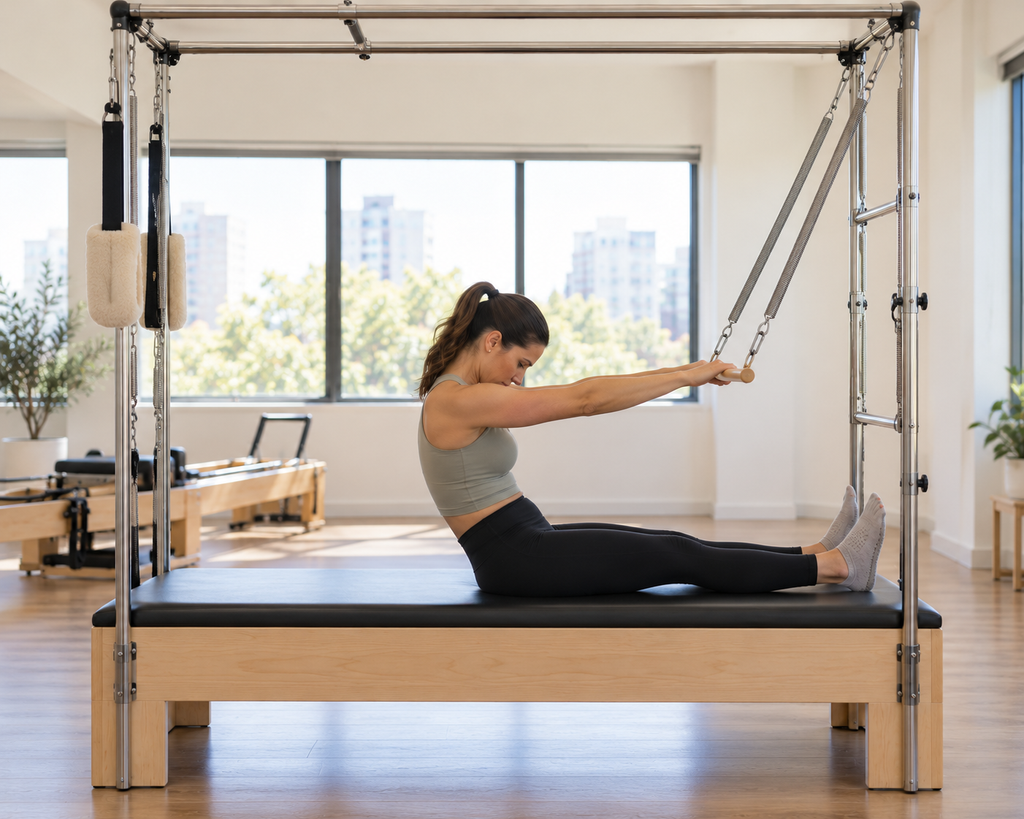
- Fitted active-wear: loose tops can ride up when you’re bridging or lying on your back, and loose shorts can be awkward with your feet in the straps.
- Grip socks: they keep you steady on the reformer and chair and are standard in most studios.
- No zips, buckles or jewellery: these can scratch the upholstery or get caught in the equipment.
- A water bottle and small towel.
- Hair tied back so it doesn’t catch on the headrest or straps.
- Any relevant reports: for Clinical Pilates, bring scan results or surgical notes if you have them.
Try to arrive about 10 minutes early for your first session so you can settle in. We’re a short walk from Central Station, which makes it easy to fit a class in before or after work in the Sydney CBD. Check our Pilates class timetable for current session times.
Starting Pilates with an injury or pain
Pilates with an injury is one of the most common reasons people walk through our door. It might be an office worker with a lower back that flares every time they try a fast-paced class, or a runner who’s had three weeks off with Achilles pain and wants to rebuild strength before running again.
The evidence is encouraging. A Cochrane review (Yamato et al., 2015) found that Pilates improved pain and disability in people with chronic low back pain compared with minimal intervention, although it wasn’t clearly better than other forms of exercise. The takeaway is that well-dosed exercise you’ll stick with is what matters, and Pilates is a good option for many people.
Where a physio-led approach helps is in getting the dose right. That means:
- Choosing the right starting point based on your assessment, not a generic class plan.
- Modifying exercises so you can load the area without provoking symptoms.
- Monitoring your response. A common approach is that mild discomfort during exercise is acceptable if it settles by the next morning, an approach used in tendon rehab (Silbernagel et alt., 2007).
- Progressing deliberately as your tolerance improves.
This fits our Relieve → Restore → Elevate pathway. Physio treatment helps settle pain first (Relieve). Clinical Pilates then rebuilds strength and control (Restore). From there, many people move into small group Pilates, strength and conditioning or running coaching to keep progressing (Elevate). If you’re not sure where you fit, book in with our physiotherapy team. No GP referral is needed.
How long before you notice a difference with Pilates?
There’s no set timeline, because everyone starts from a different place. That said, many people notice early changes in body awareness and control within the first few weeks of regular sessions: sitting at a desk feels easier, getting off the floor feels smoother, or a run feels more stable through the hips.
Those early changes are largely about your nervous system learning to coordinate movement more efficiently. Visible changes in muscle strength and tone generally take longer and depend on consistency. Things that influence your progress include:
- How often you train each week
- Whether you’re managing pain or an injury
- Your training history and other exercise
- Sleep, stress and recovery
- How well your program is matched to your goals
Rather than watching the calendar, look for practical markers. Can you hold a position with better control? Do you have fewer flare-ups? Are exercises that felt awkward in week one now feeling familiar? Those are signs you’re on track.
Private vs small group (max 4): which suits beginners?
Both formats can work well for beginners. The right one depends on your confidence, your body and your budget.
Private sessions
Private sessions give you full attention from your instructor or physio. They’re a good fit if you’re managing an injury, feeling nervous about starting, have a specific goal, or need flexible session times. Private Clinical Pilates sessions with Harry or Mikayla are physio-delivered and claimable as physiotherapy. For private sessions with our Pilates instructor Narelle Clark, health fund claims depend on your fund and level of cover, so it’s worth checking with your fund before you book.
Small group classes
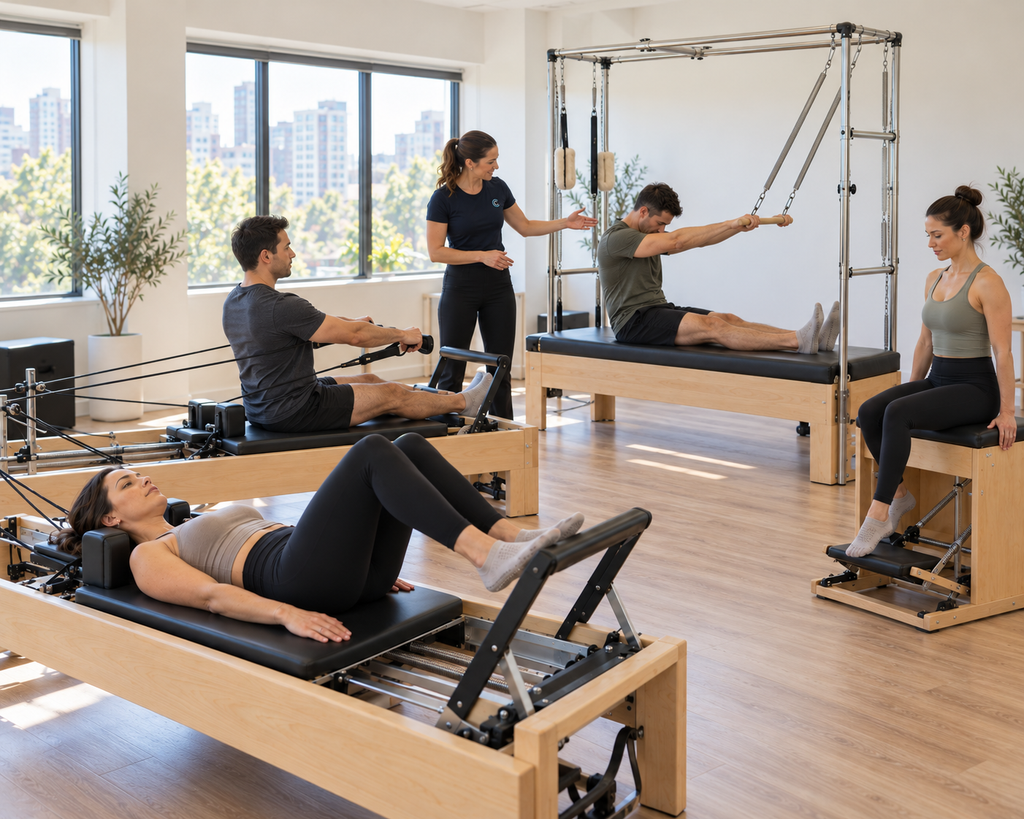
Our Contemporary Pilates small group classes have a maximum of four people. That’s small enough for your instructor to watch your technique and adjust springs and positions for you, and large enough to enjoy the energy of training with others. Small groups usually cost less per session than privates, and you can compare options on our price list.
A common beginner pathway
Many beginners start with a few private sessions to learn the fundamentals and get comfortable on the equipment, then move into a small group. If you’re starting with pain or an injury, beginning with Clinical Pilates and transitioning to small group classes once you’re ready is a sensible progression.
Not a beginner to exercise? Pilates still has a place
You might already run, lift, swim or play sport and wonder whether Pilates is worth adding. For many people, it fills a gap. Runners often use it to build hip and trunk control for the single-leg demands of running. Lifters use it to improve mobility and control through end ranges. Desk-bound workers use it to break up long hours of sitting with movement that feels manageable.
The principles are the same as for any beginner: start at the right level, focus on quality, and build gradually. Even experienced athletes are often surprised by how challenging slow, controlled work on the reformer and chair can be.
Pilates for beginners: signs to see a physio first
Pilates is low-impact and suits most people, but some situations call for an assessment before you start. Book in with a physio if you have:
- Pain that’s getting worse over several weeks, or pain that wakes you at night
- Pins and needles, numbness or weakness in your arms or legs
- Recent surgery, a fracture or a significant injury
- A history of bone stress injuries, or osteoporosis, as some exercises may need modifying
- Significant swelling, or difficulty bearing weight on a leg
- Pain that flares for more than a day after exercise
Seek urgent medical care if back pain comes with changes in bladder or bowel control, or numbness around the groin or inner thighs. See your GP if back pain comes with fever, unexplained weight loss or feeling generally unwell.
None of these mean Pilates is off the table. They just mean it’s worth getting assessed first so your program starts in the right place.
Get Expert Help – Pilates for Beginners in Sydney
If you’re thinking about starting Pilates, or you’ve tried a class and weren’t sure it suited you, the most important step is starting at the right level.
At Central Performance, we focus on:
- A one-on-one physio assessment before Clinical Pilates if you have pain or an injury
- Beginner-friendly sessions on the reformer, chair, barrel and mat
- Contemporary Pilates small groups capped at four people
- A clear path from rehab into strength, running and performance goals
You’ll work with experienced physios who understand both injury management and performance — so you’re not just recovering, you’re progressing.
Next step: Book a Clinical Pilates assessment or a beginner small group class in Surry Hills and start with a clear plan.
You can book online or ask a question by clicking below, or call our friendly reception team on 9280 2322.
Relieve. Restore. Elevate.
Related reading
- Clinical Pilates in Sydney
- Contemporary Pilates small group classes
- Pilates and group class timetable
- Central Performance price list
- Physiotherapy in Surry Hills
Pilates for beginners – FAQs
Is Pilates good for beginners?
Yes. Pilates suits beginners because exercises can be scaled to almost any starting level. Early sessions focus on breathing, trunk control and alignment before adding load or complexity. Starting in a small group or private session means your instructor can adjust springs and positions for you, so you build a solid foundation rather than trying to keep up with a fast-paced class.
Is reformer Pilates OK for beginners?
Yes, reformer Pilates is fine for beginners when the class is pitched at the right level. The springs can assist movements as well as add resistance, which often makes exercises easier to learn than on the mat. The key is a small class or private session where your instructor can teach you the equipment and correct your technique as you go.
How many Pilates sessions before I see results?
It varies from person to person, so there’s no fixed number. Many people notice better body awareness and control within the first few weeks of regular sessions, such as sitting more comfortably or moving more smoothly. Changes in strength and muscle tone usually take longer and depend on how often you train, your starting point and whether you’re managing an injury.
How often should a beginner do Pilates?
Two to three sessions a week is a common target for beginners, but one session a week is still worthwhile, especially alongside other exercise. Consistency matters more than frequency. If you’re starting with pain or an injury, your physio will guide how often to train based on how your body responds and how quickly symptoms settle after each session.
What should I wear to Pilates?
Wear fitted, comfortable active-wear that lets you move freely without riding up when you lie down or bridge. Grip socks are recommended for stability on the reformer and chair. Avoid zips, buckles and jewellery that can scratch the equipment or catch on straps. Bring a water bottle and a small towel, and tie long hair back.
Can I do Pilates if I’m not flexible?
Yes. You don’t need to be flexible to start Pilates, and improving mobility is one of the reasons many people take it up. Exercises can be modified to suit your current range of movement, and props or spring settings can make positions more comfortable. Over time, many people find they move more freely through their hips, spine and shoulders.
Can I start Pilates with back pain or an injury?
Often, yes, but it’s worth getting assessed first. A physio can check what’s going on, rule out anything that needs medical attention, and design a Clinical Pilates program that loads the area safely. Research supports Pilates as one helpful exercise option for chronic low back pain. Seek urgent care if back pain comes with bladder or bowel changes or numbness.
Do I need a referral for Clinical Pilates?
No. You don’t need a GP referral to see a physiotherapist or start Clinical Pilates. Your first step is usually an initial physio assessment, where your physio looks at your history, movement and goals before building your Pilates program. If you’re claiming under a Workers Compensation, DVA or CTP arrangement, different referral rules apply, so check with us first.
Can I claim Pilates on private health insurance?
It depends on the type of Pilates and your cover. Clinical Pilates delivered by a physiotherapist is claimable as physiotherapy if you have extras cover that includes physio. For other private Pilates sessions, claims depend on your fund and level of cover, so check with your health fund before booking. Our reception team can explain which item applies to your session.
Written by Mikayla Mestousis — APA Physiotherapist, Certified Running Coach, Pilates Instructor & S&C Coach
