

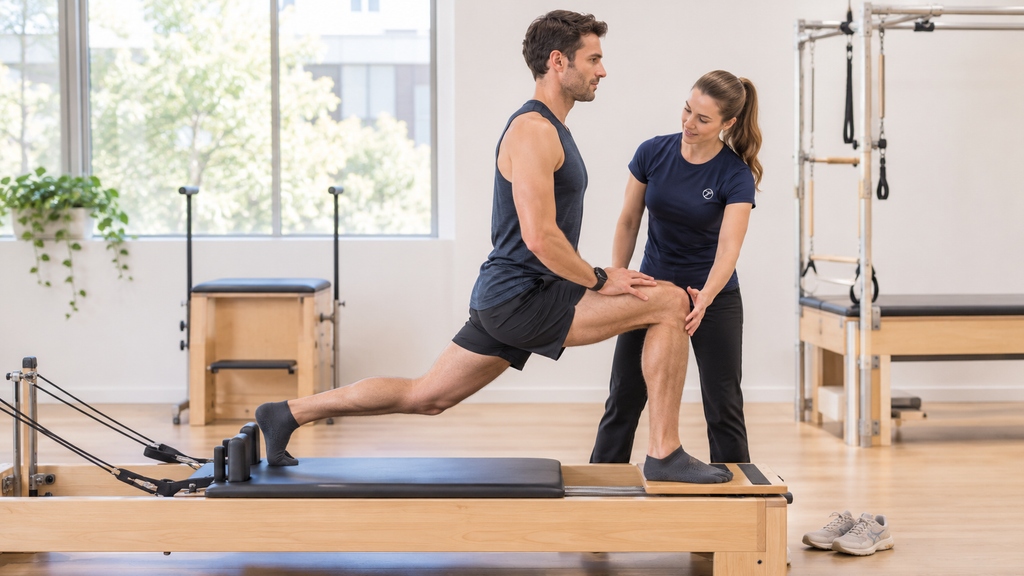
Pilates for runners is worth it for most people, as long as it’s chosen for the right reasons and fitted around your running. It won’t replace your long run or your strength training, but it’s a practical way to build the hip control, trunk endurance, calf and foot strength, and body awareness that help you hold good form when you’re tired.
We see the same pattern often in our running clinic. A runner builds towards a half or full marathon, the kilometres go up, and somewhere around week eight a knee, hip or Achilles starts to complain. Pilates won’t prevent every injury, but it’s one of the easiest ways to add targeted, low-impact strength and control without adding more fatigue to your legs.
In this updated guide, we look at what the research says, the five main ways Pilates helps your running, six exercises to start with, how often to do it during a marathon build, and how Pilates fits with strength training and yoga.
Key takeaways
- Research suggests Pilates can improve running economy and performance when it’s added to normal run training, although the studies are small.
- Pilates helps runners most with single-leg control, hip strength, trunk endurance, calf and foot strength, and breathing.
- Most runners do well with one or two Pilates sessions a week, scaled back during peak and taper weeks.
- Pilates complements strength training rather than replacing it. Heavier lifting is still important for bone, tendon and power.
- If you have knee, hip or back pain, physio-led Clinical Pilates lets you keep training while your rehab is tailored to you.
Is Pilates good for runners? What the research says
The research on Pilates for runners is still growing, but the early findings are encouraging.
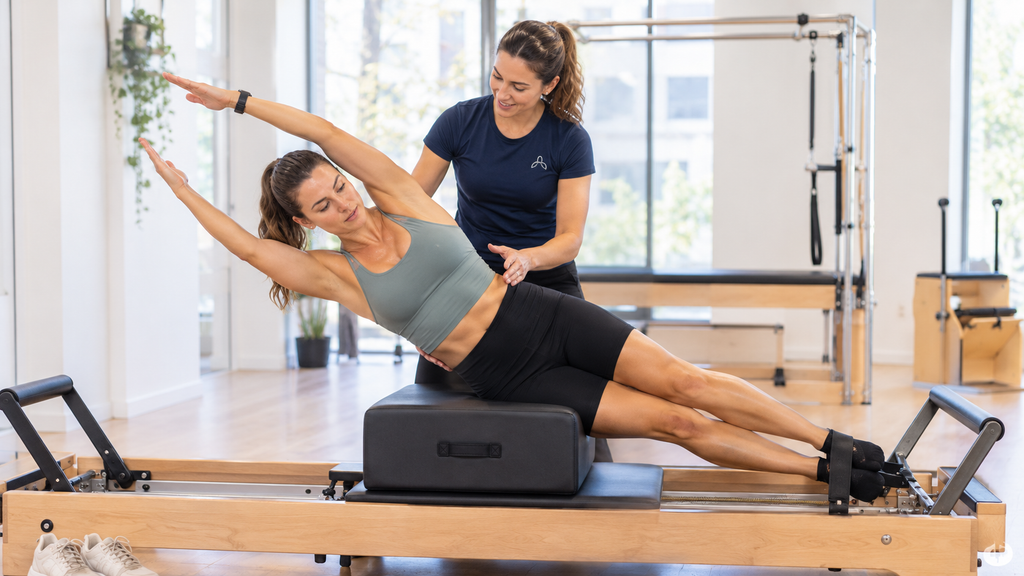
- Finatto et al., 2018: in a randomised trial of trained recreational runners, the group that added two one-hour mat Pilates sessions a week to their running for 12 weeks improved their 5 km time significantly more than the group who only ran. The Pilates group also had a lower metabolic cost of running, meaning they used less energy at the same speed.
- Hung et al., 2019: a small study of college athletes found that eight weeks of core training, three times a week, improved core endurance and running economy compared with a control group.
Both studies are small, so they don’t prove that Pilates will make every runner faster. What they do suggest is that targeted trunk and hip work can help you run more efficiently, particularly late in a run when form tends to fade. That fits with what we see clinically: runners who build better control usually hold their technique for longer.
5 ways Pilates helps your running
1. Single-leg control
Running is a series of single-leg landings. Each step asks your hip, knee and foot to stay aligned while absorbing several times your body weight. Pilates trains that control slowly and precisely, so the pattern is easier to hold at speed.
2. Hip strength
Your glutes, particularly gluteus medius, help keep your pelvis level and stop your knee drifting inward on landing. Side-lying leg work, bridges and standing reformer exercises target these muscles in positions that suit runners.
3. Trunk endurance
Your trunk transfers force between your legs and arms. When it fatigues, many runners start to slump, over-stride or rotate excessively. Pilates builds the endurance to hold a tall, stable position through the later kilometres.
4. Calf and foot strength
Your calf and soleus muscles do a large share of the work in running, and your foot muscles help control each landing. Reformer footwork and Wunda chair pedal work load the calves and feet in a controlled way, which is useful both for performance and for runners managing Achilles or plantar heel pain.
5. Breathing
Pilates teaches you to coordinate breathing with movement and to expand your ribcage fully. Many runners find this helps them settle their breathing rhythm and stay relaxed through the shoulders and neck when the pace lifts.
6 Pilates exercises for runners
These are some of our go-to Pilates exercises for runners. Several use equipment, so they’re easiest to learn in a supervised session first. Aim for smooth, controlled movement rather than speed.
1. Single-leg footwork on the reformer
Targets: calf, soleus, foot control and knee alignment. Lying on the reformer with one foot on the footbar, press the carriage out and back, then add slow heel raises at the end of the range. Keep your knee tracking over your second toe.
2. Single-leg bridge
Targets: glutes, hamstrings and pelvic control. Lying on your back with one foot planted, lift your hips without letting the pelvis drop on the unsupported side. Hold briefly at the top, then lower with control.
3. Side-lying leg series
Targets: gluteus medius and hip stability. Lying on your side with your body in a straight line, lift and lower the top leg slightly behind your body, keeping your pelvis still. Add small circles or a light resistance band as you progress.
4. Reformer front lunge
Targets: hip extensor strength, hip flexor length and balance. Standing with one foot on the platform and the other on the moving carriage, slide into a lunge and return with control. This mirrors the hip extension you need at push-off.
5. Wunda chair step-up
Targets: single-leg strength, knee control and balance. Stand facing the chair with one foot on top, then press through that leg to step up while the pedal assists or resists. Keep your pelvis level and your knee in line with your foot.
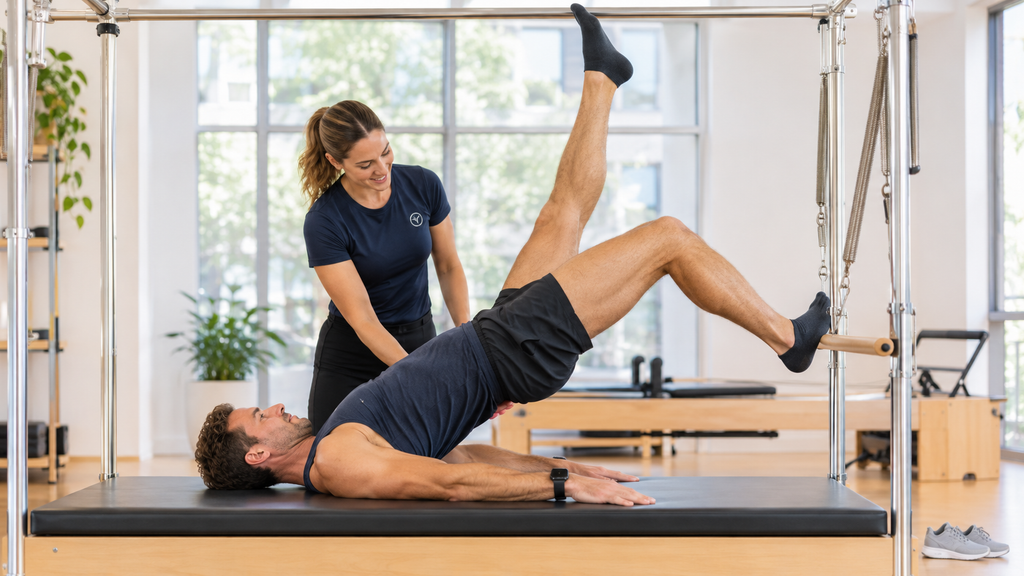
6. Dead bug with leg extension
Targets: trunk control and the coordination of opposite arms and legs. Lying on your back with arms and knees lifted, slowly extend one leg and the opposite arm while keeping your lower back steady, then switch sides. It trains the same opposite-limb pattern you use when running.
If any of these cause pain, or you’re unsure about technique, a physio-led Clinical Pilates session can tailor the exercises and loads to you.
Pilates for runners with knee, hip or back pain
Clinical Pilates is often how our runners keep training while they rehab. Because it’s delivered by a physiotherapist, the program is built around your assessment, symptoms and running goals.
- Runner’s knee (patellofemoral pain): combined hip and knee strengthening is a well-supported treatment (Crossley et al., 2016). Pilates for runner’s knee typically includes glute, quad and single-leg control work, progressed carefully so the knee isn’t flared.
- Hip and ITB-related pain: hip abductor strength and pelvic control are usually a focus, alongside changes to training load.
- Achilles and calf pain: reformer and chair work provides graded calf loading that can be built up alongside a tendon rehab program.
- Low back pain: research supports Pilates as one of the more effective exercise options for chronic low back pain (Owen et al., 2020).
Pilates is most useful as part of a full rehab plan rather than on its own. If your pain isn’t settling, our running physio team can help work out why. Our post on why a running injury isn’t getting better covers the most common reasons.
Pilates vs yoga vs strength training for runners: do you need all three?
Not necessarily. Each one does a different job, so the right mix depends on your goals and how much time you have.
- Strength training: heavier, progressive loads build muscle, tendon and bone capacity and power. It’s been shown to improve running economy (Blagrove et al., 2018). For most runners, this is the priority.
- Pilates: builds control, trunk endurance, single-leg alignment and body awareness, with low fatigue. It’s a strong complement to strength training.
- Yoga: mainly helps with mobility, breathing and relaxation. It can be a useful recovery session but provides less strength stimulus.
When runners ask us about Pilates vs yoga, our answer is usually that Pilates offers more targeted strength and control, while yoga offers more mobility and recovery. If you only have time for two sessions a week outside running, we’d suggest one strength session and one Pilates session.
How often should runners do Pilates?
For most runners, one to two Pilates sessions a week works well. Two sessions a week is what was used in the Finatto study. During heavier training blocks, one session is often enough to keep the benefits without adding fatigue.
Sample week in a marathon build
- Monday: rest, or a Pilates session (45–55 minutes)
- Tuesday: quality run (intervals) + strength session later in the day
- Wednesday: easy run
- Thursday: tempo or threshold run + shorter strength session
- Friday: easy run or rest, with optional mobility
- Saturday: long run
- Sunday: rest or easy recovery run
The idea is to keep hard days hard and easy days easy, so your strength work sits on your quality days and Pilates sits on lighter days. As you approach race day:
- Peak weeks: keep Pilates to one session and lower the intensity.
- Taper: keep a lighter Pilates session for control and mobility, and avoid introducing new exercises.
- Race week: a short, easy session early in the week is plenty.
Treat this as a starting template. A RunRight coach can adjust it to your race, experience and weekly schedule.
Pilates for runners at Central Performance
Being next to Central Station, we see a lot of runners from Surry Hills, Redfern and the Sydney CBD, so our Pilates, coaching and strength programs are designed to work together.
- Clinical Pilates: Clinical Pilates in Sydney with Mikayla Mestousis starts with a physio assessment and is built around your running and any injury history. It’s physio-delivered and claimable as physiotherapy.
- RunRight coaching: RunRight running coaching combines video analysis with hands-on coaching to improve your technique and efficiency. If you’re already doing Pilates with us, it’s the natural next step to carry that control into your running.
- Strength and conditioning: our strength and conditioning for runners program builds the heavier strength and power that Pilates doesn’t cover.
- Running physio: if you’re injured, our running physio team can guide your rehab and return to running.
If you’re not injured and just want to add Pilates to your training, our Contemporary Pilates small group classes have a maximum of four people. New to Pilates? Start with our Pilates for beginners guide.
Not a runner? The same principles apply
The control, hip strength and trunk endurance that help runners are just as useful for cyclists, team sport players, people who walk long distances and anyone who spends long days at a desk.
Pilates for runners: when to see a running physio first
Pilates is low-impact and suits most runners, but get assessed before you start, or before you keep running, if you have:
- Pain that’s getting worse each run, or pain that changes how you run
- Sharp, localised pain on a bone, especially in the shin, foot or hip, or pain on hopping
- Pain at rest or pain that wakes you at night
- Pins and needles, numbness or weakness in your legs
- Significant swelling, or difficulty bearing weight
- An injury that keeps coming back every time you build your mileage
These don’t mean you can’t do Pilates. They just mean your program should be built around a proper assessment. No GP referral is needed to see a physio.
Get Expert Help – Pilates for Runners in Sydney
If you’re training for your next race, or a niggle keeps interrupting your running, the most important step is getting on the right plan early.
At Central Performance, we focus on:
- A physio assessment that looks at your running, history and goals
- Clinical Pilates programs built around your training
- RunRight coaching to carry better control into your running technique
- Strength and conditioning to build the capacity your running needs
You’ll work with experienced physios who understand both injury management and performance — so you’re not just recovering, you’re progressing.
Next step: Book a Clinical Pilates session with our physio team in Surry Hills and build Pilates into your running plan.
You can book online or ask a question by clicking below, or call our friendly reception team on 9280 2322.
Relieve. Restore. Elevate.
Related reading
- Clinical Pilates in Sydney
- RunRight running coaching
- Running physio in Sydney
- Why your running injury isn’t getting better
Pilates for runners – FAQs
Is Pilates good for runners?
Yes, Pilates is good for most runners. It builds single-leg control, hip strength, trunk endurance and calf and foot strength with low impact and little added fatigue. Small studies suggest adding Pilates to run training can improve running economy and performance. It is most useful alongside running and strength training, not as a replacement for either.
What is better for runners, yoga or Pilates?
Pilates usually offers runners more targeted strength and control, especially for the hips, trunk and calves. Yoga is generally more focused on mobility, breathing and relaxation. Both can be useful. If you can only choose one alongside strength training, Pilates is often the more running-specific option, while yoga can work well as a recovery session.
How often should runners do Pilates?
One to two Pilates sessions a week suits most runners. Two sessions a week was used in research showing performance benefits, while one session is often enough during heavy training blocks. Schedule Pilates on easy days or rest days, and lower the intensity during peak weeks and your taper so it doesn’t add fatigue before key runs.
Which Pilates exercises are good for runners?
Good Pilates exercises for runners include single-leg footwork on the reformer, single-leg bridges, the side-lying leg series, reformer lunges, Wunda chair step-ups and dead bugs. Together they target the calves, glutes, hips and trunk, along with single-leg control. The right selection and loads depend on your running, injury history and goals.
Can Pilates help runner’s knee?
Yes, Pilates can be a useful part of managing runner’s knee. Strengthening the hips and quads, and improving single-leg control, are well-supported treatments for patellofemoral pain. Physio-led Clinical Pilates lets these exercises be tailored and progressed without flaring the knee. It is most useful alongside changes to training load and a broader rehab plan.
Should I do Pilates before or after a run?
For most runners, Pilates fits well after an easy run or on a non-running day. A short Pilates-style warm-up of five to ten minutes before a run is fine. Avoid a hard Pilates session before intervals, tempo runs or long runs, as fatigued trunk and hip muscles can affect your form when it matters.
Can Pilates replace strength training for runners?
Not completely. Pilates builds control and endurance, but the load is limited, so it doesn’t fully replace heavier strength training. Progressive strength work is important for bone, tendon capacity, power and running economy. Most runners do well with one or two strength sessions and one Pilates session a week, depending on their training phase.
Is reformer Pilates good for runners?
Yes. Reformer Pilates suits runners well because the springs can load the calves, hips and legs in single-leg positions, which mat work can’t do as easily. Exercises like footwork, lunges and standing work on the reformer closely relate to running. Starting with supervised sessions helps you learn the equipment and choose the right spring settings.
Can Pilates make you a faster runner?
It can help. In one 12-week trial, runners who added two mat Pilates sessions a week improved their 5 km time more than those who only ran, and used less energy at the same speed. The study was small, so results vary. Pilates is most effective alongside well-structured run training and strength work.
Written by Mikayla Mestousis — APA Physiotherapist, Certified Running Coach, Pilates Instructor & S&C Coach
