

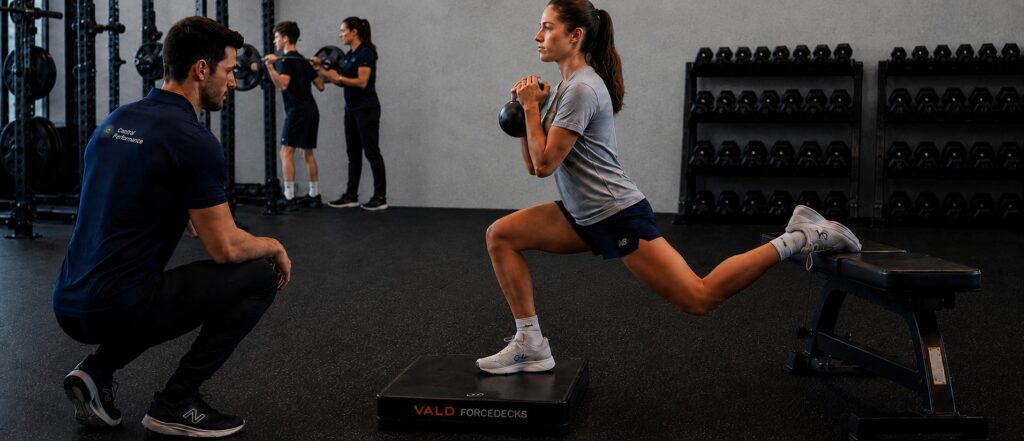
Faster and more agile on the field. Stronger under contact. Harder to injure. That’s the promise of strength training for young athletes when done properly — and it’s no longer just a theory. A solid and growing body of sports-science research shows that structured strength training can meaningfully reduce injury risk in adolescent athletes, while directly improving the speed, power and agility that separate good players from great ones.
Central Performance’s Strength Training for Young Athletes program in Surry Hills is built specifically for adolescent athletes. It covers all major sports including soccer, netball, football, rugby, basketball, running and beyond. Every session is designed and led by coaches who hold qualifications in both physiotherapy and strength & conditioning. This dual qualification is critical because it allows one program to deliver maximal benefits in the two key areas of performance improvement and injury minimisation – with the coach being an expert in both, so young athletes train hard and stay safe.
Key Takeaways
- Strength training can reduce injury risk in adolescent athletes by up to 30%, based on multiple independent studies — while also improving speed, power and performance
- Every coach in this program is a qualified physiotherapist and a certified strength & conditioning coach, so injury reduction and performance gains happen in the same session — not as two separate services
- The training principles are backed by the same evidence base behind FIFA’s, Netball Australia’s and elite rugby’s own injury-prevention programs
- Properly supervised strength training is safe for adolescent athletes and does have any effect on growth — a persistent myth that current research firmly rejects
- Suitable for any sport and any level, from recreational through to representative and elite
Dual-Qualified Coaches – Physios and Certified Strength and Conditioning Coaches
We really care about the young athletes we train, so as well as helping them perform at their best we also focus on minimising their injury risk. That’s why all of our coaching team are physiotherapists with additional qualifications in strength and conditioning. Their physio expertise means they can pinpoint and correct any movement problems that could increase the risk of injury, and their strength training certifications allow them to program sessions that are structured for maximal gains in strength, power and performance. This means every session is built with two goals: reducing injury risk and building real athletic performance, rather than one at the expense of the other.
Peace of Mind For Parents
For parents, these dual physio and strength coach qualifications mean your child is being trained by a professional coach with the clinical knowledge to recognise and train around any existing injury, minimise the risk of future injuries, and the performance training to program sessions that are challenging but perfectly matched to your child’s ability. Learning correct movement patterns and exercise technique is vital at this stage of athletic development, and physios are recognised as experts in assessing and correcting movement control, then developing the athlete’s ability to maintain correct form under load and fatigue.
Who Is This Program For?
This program is built for adolescent athletes across any sport — recreational through to representative and elite level. Whether you’re chasing selection, trying to hold down your spot in the starting side, or just want to feel stronger and more confident on the field or court, this program is designed around your sport and your goals.
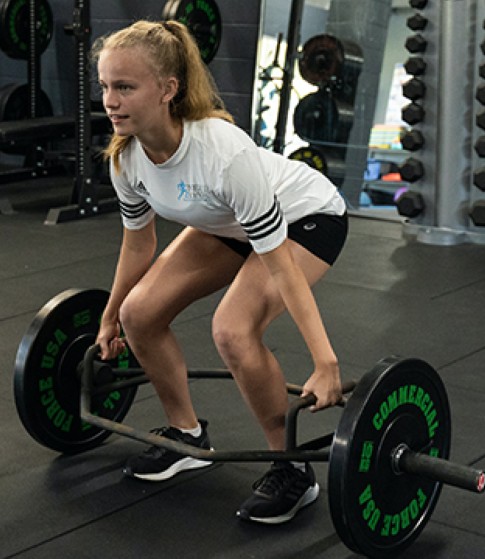
Soccer: players get more out of every contest — more acceleration to reach the ball first, more power to win the ball in a tackle, and better change-of-direction to beat a defender or track back. In one study, adolescent soccer players who added just six weeks of plyometric and sprint training to their normal training improved sprint speed by up to 3.2%, jump height by 7.7%, and kicking velocity by up to 6.6%. A large 2026 meta-analysis of over 2,000 adolescent team-sport athletes found strength and plyometric training produced their biggest, most consistent gains specifically in acceleration and change-of-direction speed — exactly the qualities that decide 50/50 contests and who gets to the ball first.
Netball: the same qualities — explosive power, reactive strength and controlled landing mechanics — translate directly into faster drives, higher intercepts, and safer landings under fatigue late in a game. Given netball’s well-documented ACL injury risk, particularly for adolescent female athletes, this is also where the injury-prevention side of training matters most.
Rugby (union and league) and AFL: players benefit from greater acceleration and force production to win collisions and beat defenders, along with the structural resilience that comes from properly loaded strength work — the same principle behind programs like Activate, shown to cut match injuries by up to 72% in schoolboy rugby with full compliance.
Running: strength training for runners builds the resilience to handle higher training volumes without breaking down, along with improved running economy — meaning you can hold your pace for longer with less energy cost. There are also specific benefits of strength training for adolescent runners. It’s one of the two most well-supported ways to prevent common running injuries like shin pain, Achilles tendinopathy/tendinitis, and runners knee.
The same training principles apply just as well to basketball, hockey, tennis, hockey, or any sport that demands speed, power, agility and resilience.
What Is Strength Training for Young Athletes?
It’s a strength & conditioning program designed specifically for adolescent athletes — built to develop the strength, power and movement quality that reduce injury risk and improve performance in sport.
Sessions run for 45 minutes in our fully equipped Surry Hills gym. You’ll start with 1:1 (private) coaching, so your program and technique are shaped entirely around you — your sport, your current strength level, and any injury history. From there, and depending on availability, there’s the option to progress into partnered or small group sessions.
Why Strength Training for Young Athletes Matters
This isn’t a trend — it’s backed by a substantial body of sports-medicine research, including studies specifically in adolescent team-sport athletes.
Strength training can reduce injury risk in adolescent athletes by up to 30% — while also improving speed, power and performance.
Based on independent systematic reviews of adolescent team-sport athletes, not a single study.
The Same Principles Behind FIFA, Netball Australia and Elite Rugby
Some of the best-known injury-prevention programs in world sport — FIFA’s 11+ program in soccer, Netball Australia’s KNEE Program, and rugby’s Activate program — are built around the same core idea: combining strength, balance, agility and movement control cuts injury rates significantly. These programs have been shown to reduce injury incidence by roughly a third to a half across soccer, netball and rugby, with some sport-specific programs reporting even larger reductions in ACL injury risk for adolescent athletes — particularly female athletes in netball and soccer. Our program is built on these same evidence-based principles, with a focus on loaded strength training.
Better Performance, Not Just Fewer Injuries
Research consistently shows resistance and power training improves strength, jump height, sprint speed, acceleration and change-of-direction speed in youth athletes — and the effect is larger in adolescents than in younger children, and larger in girls than in boys. In one study, six weeks of plyometric and sprint training in adolescent soccer players improved sprint speed by up to 3.2%, jump height by 7.7%, and kicking velocity by up to 6.6%. A large 2026 meta-analysis of 69 studies and over 2,000 adolescent team-sport athletes found the biggest, most consistent gains were specifically in 0–10m acceleration and change-of-direction speed — the qualities that most directly translate to game situations. In other words, the teenage years are exactly the right window to start strength training.
Is Strength Training Safe for Teenagers?
Yes — when it’s properly supervised. The idea that lifting weights stunts growth or damages growth plates is a persistent myth that current research firmly rejects. International sports-medicine consensus — including the Australian Strength and Conditioning Association (ASCA) — confirms that well-supervised resistance training doesn’t harm growth, and can actually strengthen bone during the growth-spurt years when young athletes are most vulnerable to injury. The Australian Physical Activity Guidelines recommend children and adolescents aged 5–17 do strengthening activities at least three days a week.
What Makes Our Program Different
Plenty of gyms offer generic teenage strength classes. What’s different here is who’s coaching, plus access to elite-level performance testing equipment with VALD technology.
Every coach in our program is a qualified physiotherapist and a certified strength & conditioning coach. That combination matters: it means every session is designed with two goals at once — reducing injury risk and building real athletic performance — rather than one or the other.
We use VALD ForceDecks force-plate testing — the same technology used by professional sporting teams — to build an objective picture of your strength, power and movement that simply isn’t visible to the human eye alone.
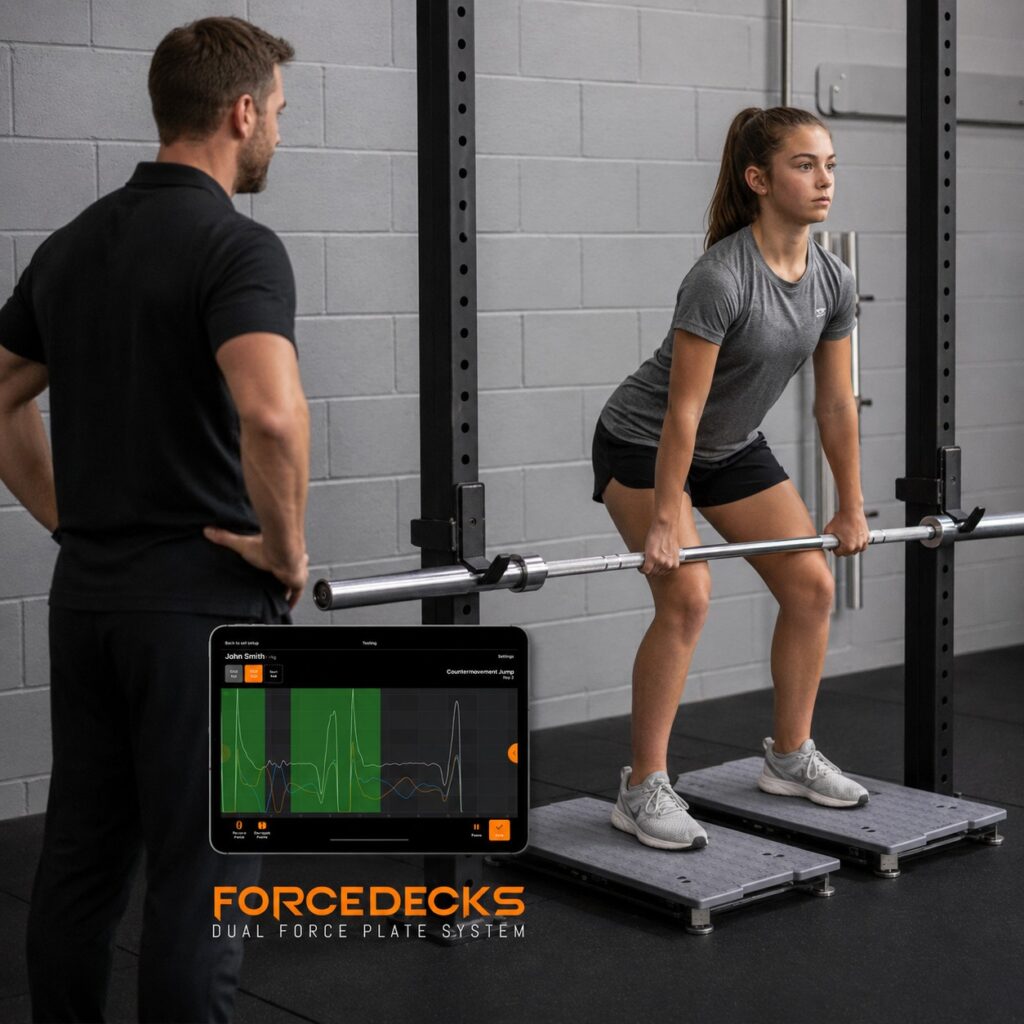
A coach watching you jump can see how high you jumped. What they can’t see is how quickly you produced that force (part of what is called the reactive strength index, RSI), whether one leg is quietly compensating for the other, or whether your explosive power is actually improving week to week. VALD ForceDecks measure every variable across fraction-of-a-second intervals during every test, including:
- Reactive Strength Index (RSI) — how efficiently you absorb and reproduce force on landing, a key marker of explosive power and injury resilience for sprinting, jumping and changing direction
- Left/right asymmetries — imbalances between limbs that are linked to elevated injury risk, and are very difficult to detect through visual assessment alone
- Peak power and force output — objective tracking of explosive strength as it develops over time
- Ground contact time and braking strategy — how efficiently you absorb load, which affects both performance and injury risk
This data is benchmarked against normative values by age, gender and sport, so your program is guided by where you actually are — not a guess — and every testing session shows real, measurable evidence of progress.
Why Athletes and Parents Choose Central Performance
- Dual-qualified coaches — physiotherapy and strength & conditioning, in one
- VALD ForceDecks performance testing —elite-level technology to guide your program
- Close, 1:1 supervision from day one
- Sessions may be eligible for private health fund rebates (physiotherapy extras cover, subject to your fund) — HICAPS claims on the spot
Program Structure: What to Expect
Every athlete starts the same way: with a full initial assessment, before any loaded training begins.
Your First Session
Your first session is a comprehensive assessment, not a workout. Your coach — a physiotherapist and strength coach — will cover:
- Your training and sporting history, including your current sport(s), competition level, and where you’re at in your season
- Your performance goals — what you actually want to get out of the program, whether that’s more power, better speed, injury resilience, or a combination
- Your strength training experience, so your program starts at the right level, whether you’ve never touched a barbell or you’re already training regularly
- A full injury history, including any past or current niggles, so your program works around — not against — any existing issues
- A movement screen, assessing fundamental movement patterns like squatting, lunging and single-leg control, to flag any areas of compensation or restriction before load is added
- Baseline VALD ForceDecks testing, giving us an objective starting point for your strength, power and any asymmetries, so every future session can be measured against real data
- Specific areas you want to work on, whether that’s a known weakness, a past injury, or a physical quality that’s holding your performance back
This first session becomes the baseline for everything that follows. Your movement screen, your VALD test results, your goals and your injury history all feed directly into a program built specifically around you — not a generic template with the edges adjusted. As your strength and testing results develop, we revisit that baseline regularly, so your program keeps evolving as you improve. And re-testing using VALD performance technology during your program ensures your program is progressed based on solid data, not guesswork.
Personalised, One-to-One Coaching
Sessions run for 45 minutes in our fully equipped Surry Hills gym. You’ll start with 1:1 (private) coaching, so every session — every exercise, every rep range, every load — is tailored specifically to you: your sport, your goals, your strength level and your injury history. This isn’t a generic teenage strength class. It’s a program built around one athlete: you.
From there, and depending on availability, there’s the option to progress into partnered or small group sessions — a great way to train alongside teammates or friends once your technique and program are established.
Build Rock-Solid Technique From The Start
Learning correct technique early is one of the most important — and most overlooked — parts of strength training for young athletes. Good movement patterns learned now become the foundation for a lifetime of training, while poor technique learned early can be hard to unlearn and increases injury risk as loads increase.
This is where the dual qualification of our coaches matters most. As physiotherapists, they understand exactly how movement faults translate into injury risk — not just what looks wrong, but why it’s a problem and what to do about it. As certified strength coaches, they know how to build technique progressively, adding complexity and load only once a movement pattern is genuinely mastered.
Getting this right early maximises the results you get from training and minimises injury risk as the weights get heavier and the demands of your sport increase. This is a major focus of our coaching, and it’s an area we consider ourselves genuine experts in — well worth considering when choosing where your young athlete trains.
Spots in our strength training for young athletes program are limited.
For more information please Call us on 9280 2322 or contact us to find out more.
Strength Training for Young Athletes: Frequently Asked Questions
What age can my child start strength training?
There’s no single age — readiness matters more than age. The Australian Strength and Conditioning Association (ASCA) recommends structured resistance training can begin from around age 6, provided a child can follow coaching instructions safely, and readiness generally aligns with being ready for organised sport. This program is aimed at adolescent athletes already playing organised sport.
What sports is this suitable for?
Any sport. We see the strongest research base in soccer, netball and rugby, but the training principles — strength, power, movement control — transfer directly to running, basketball, athletics, tennis and beyond.
Does strength training stunt growth?
No. This is one of the most persistent myths in youth sport. Current research — including the 2014 International Consensus on youth resistance training and the American Academy of Paediatrics — confirms properly supervised strength training doesn’t damage growth plates or affect height, and can actually improve bone density during adolescence.
How much can strength training reduce injury risk?
Multiple independent studies in adolescent team-sport athletes show reductions of around 30%, alongside improvements in speed and power. Some sport-specific programs, such as Netball Australia’s KNEE Program, report even larger reductions in ACL injury risk specifically.
I’ve already had an injury — is this program right for me?
Yes, absolutely — in fact, this is one of the best reasons to join. Because every coach is a qualified physiotherapist, the program can be built around completing your rehabilitation, safely returning you to sport, and then minimising your risk of re-injury going forward. Rather than working around your injury history, we build your program because of it.
Do I need gym experience to join?
No. Every athlete starts with 1:1 coaching, so your program is built around your current strength level and experience — whether you’ve never touched a barbell or you’re already training regularly.
Can I claim health fund rebates for sessions?
Because every coach is a qualified physiotherapist as well as a strength & conditioning coach, sessions may be eligible for a private health fund rebate under your physiotherapy extras cover — subject to your individual fund and level of cover. We offer HICAPS for fast, on-the-spot claims.
How is this different from a regular personal training program?
Your coach is a physiotherapist and a strength coach — not one or the other. That means injury risk factors, previous injuries and movement quality are built into your program from day one, not bolted on afterwards.
