

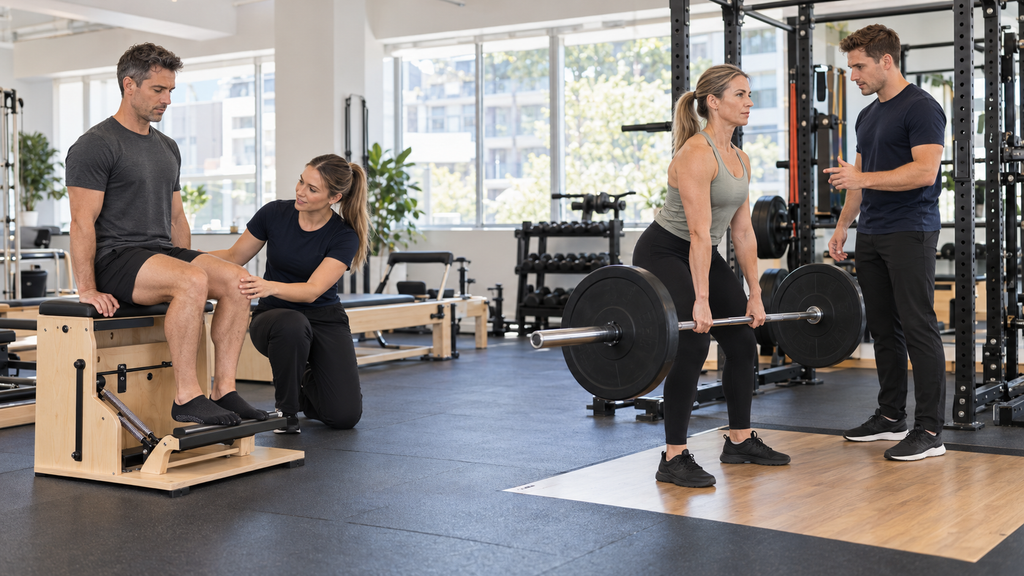
Pilates vs strength training is one of the most common questions we hear from people starting out, coming back from injury or wanting more from their training. The short answer is that they do different jobs. Pilates builds control, trunk endurance and mobility, while strength training uses progressively heavier loads to build muscle, bone and power. For most people, the most useful answer isn’t one or the other. It’s both, in the right mix.
Which one takes priority depends on your goals, your history and where you’re at right now. A runner rebuilding after a calf strain, a 45-year-old who wants to look after their bone health and an office worker with a stiff lower back will each need a slightly different balance.
In this guide, we break down what each does well, where each falls short, and how to combine them, with sample weeks you can adapt to your own schedule.
Key takeaways
- Pilates is a form of resistance training, but the load is limited, so it’s most useful alongside progressive strength training rather than as a replacement for it.
- Strength training is the most direct way to build muscle, bone density and power, and it becomes more important as you age.
- Pilates is well suited to building movement control, trunk endurance, mobility and confidence, particularly after an injury.
- For chronic low back pain, research supports both Pilates and resistance training. The right choice depends on you.
- Many people do well with two strength sessions and one Pilates session a week, adjusted to their goals and recovery.
Pilates vs strength training: the short answer
Pilates and strength training both make your muscles work against resistance. The difference is how much load is used, how it’s progressed and what each method is designed to develop.
Pilates at a glance
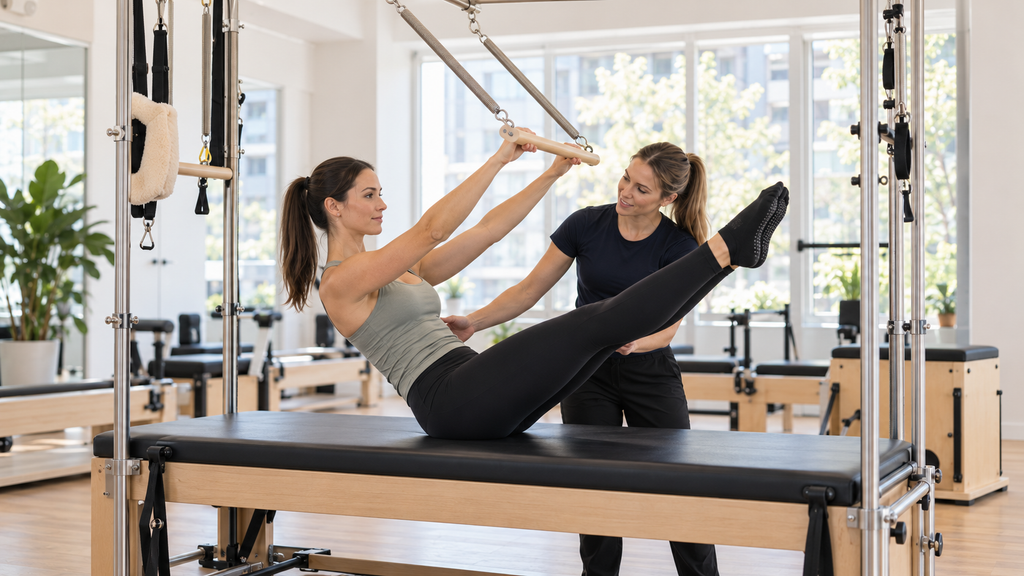
- Resistance comes from your body weight and from springs on equipment like the reformer, Cadillac and chair.
- The focus is on control, alignment, breathing, trunk endurance and mobility.
- It’s low-impact and easy to modify, which makes it well suited to rehab and to people new to exercise.
- The amount of load is limited by the springs, so there’s a ceiling on how heavy it can get.
Strength training at a glance
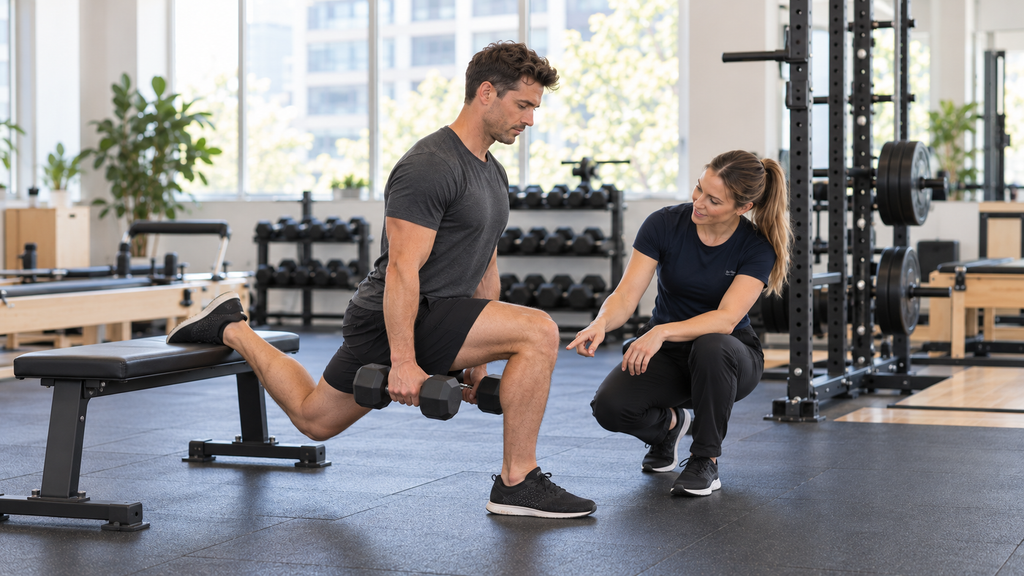
- Resistance comes from free weights, machines, cables and body weight.
- The focus is on progressive overload: gradually lifting heavier or doing more over time.
- It builds muscle size, maximal strength, power and bone density.
- It scales from light rehab loads all the way to heavy lifting and jumping.
So, is Pilates strength training? In the sense that your muscles work against resistance, yes. But it isn’t a full substitute for training with progressively heavier loads, which is what drives many of the long-term benefits for muscle and bone. The same applies when people compare Pilates vs weight training: one isn’t better than the other, they just do different things.
What Pilates does well
Pilates shines when the goal is quality of movement. It teaches you to move with control, often one segment at a time, and it rewards precision over speed. In particular, Pilates is very good for:
- Movement control and body awareness: for example, rolling down through your spine one segment at a time rather than hinging as one stiff block.
- Trunk endurance: holding positions under low load for longer, which helps with long days at a desk or the later kilometres of a run.
- Mobility through range: controlled work at the end of your range, particularly through the hips and upper back.
- Balance and single-leg control: chair and standing reformer work challenge stability in a way that’s easy to progress.
- A gentle on-ramp after injury: springs can assist a movement as well as resist it, so load can be dialled right down when you need it.
The research supports this. A large network meta-analysis of exercise for chronic low back pain (Owen et al., 2020) found Pilates was among the most effective types of exercise for reducing pain, alongside stabilisation, resistance and aerobic training. Physio-led Clinical Pilates is often how our clients rebuild confidence after a back, hip or knee injury.
Where Pilates falls short is load. Even the heaviest spring settings won’t challenge the big muscles of your legs and hips the way a loaded squat, deadlift or step-up can, especially once you’re already reasonably strong. There’s also very little impact or speed, both of which matter for bone and power.
What strength training does well: load, bone density and power
Strength training is the most direct way to make your muscles, tendons and bones more robust. Its main advantage is that it can keep progressing for years.
Progressive load
Your body adapts to the demands placed on it. Strength training lets us increase those demands in small, measurable steps, whether that’s adding weight, reps or sets. A runner who can do plenty of body weight calf raises, for example, may need loaded calf raises to keep building the capacity their Achilles and calf need for long runs.
Bone density
Bone responds to high loads and impact. In the LIFTMOR trial (Watson et al., 2018), supervised high-intensity resistance and impact training improved bone density at the spine and hip in postmenopausal women with low bone mass, and was well tolerated when it was properly coached and progressed. Evidence that Pilates on its own improves bone density is much more limited.
Power and speed
Power is your ability to produce force quickly. It’s what you use to sprint, jump, change direction and, later in life, catch yourself when you trip. Strength and conditioning programs build power with lifting and jumping drills that Pilates doesn’t really include.
Muscle as you age
Muscle mass and strength naturally decline with age, and resistance training is the main way to slow that down. Australia’s Physical Activity and Sedentary Behaviour Guidelines recommend muscle-strengthening activities on at least two days each week for adults, which is a useful baseline to plan around.
Pilates vs gym for women
We see a lot of women who do Pilates three or four times a week but have never picked up a barbell. When we talk about Pilates vs strength training for women, a few common concerns come up:
- “I don’t want to get bulky.” Building significant muscle size takes years of targeted training and eating to support it. For most women, lifting builds strength and shape gradually, not bulk.
- “The gym feels intimidating.” That’s completely understandable. Coached sessions in a small, supportive group make a big difference.
- “I’m worried about getting injured.” Well-coached strength training, progressed sensibly, has a low injury risk. Technique and appropriate loads matter far more than avoiding weights altogether.
Strength training becomes even more relevant through perimenopause and menopause, when falling oestrogen levels speed up bone loss. That’s when progressive loading of the spine and hips becomes particularly valuable.
If you’d like to try lifting in a women-only setting, our HERo women’s strength and conditioning group is designed for exactly that. Many women keep the Pilates they enjoy and add one or two strength sessions each week, rather than choosing one over the other.
Is Pilates enough on its own?
It depends on what you want from your training. Pilates on its own may be enough if:
- You’re mainly after general movement health and you’re active in other ways, such as walking, cycling or swimming
- You’re early in rehab and building confidence after an injury
- You’re returning to exercise after a long break and want a gentle starting point
You’ll likely need to add strength training if:
- You want to build or maintain bone density and muscle as you get older
- You run or play a sport that needs power, speed or change of direction
- The heaviest spring settings have started to feel easy
- You’re training towards a specific performance goal, such as a faster half marathon
If you’re stuck on Pilates or gym because you only have time for one, choose the one you’ll do consistently. Then build towards doing both.
How to combine Pilates and strength training: sample weeks
These are examples to adapt, not fixed prescriptions. Your ideal week depends on your goals, your recovery and what else you’re doing.
Getting started or returning from injury
- 1 x Clinical Pilates session
- 1 x lighter, technique-focused strength session
- 2–3 walks or easy cardio sessions
General health and longevity
- 2 x full-body strength sessions on non-consecutive days
- 1 x Pilates session
- Cardio you enjoy on other days
Runners
- 2 x strength sessions: one heavier lower-body focus, plus one that adds jumps and plyometrics as you progress
- 1 x Pilates session on an easy running day
- Keep heavy leg sessions away from the day before a key run, such as intervals or a long run
For runners, strength and conditioning has been shown to improve running economy (Blagrove et al., 2018), which is a big part of why we pair it with running coaching.
Busy weeks
- 1 x strength session and 1 x Pilates session, or
- 1 x combined session: about 30 minutes of strength work followed by 15–20 minutes of Pilates-style trunk and mobility work
A few practical tips:
- Same day? Do the heavier strength work first, while you’re fresh, then Pilates.
- Recovery: give a muscle group roughly 48 hours between hard sessions.
- Track it: keep a simple log of weights, reps and spring settings so you can see progress.
Pilates vs strength training: when to get assessed first
Both Pilates and strength training suit most people, but it’s worth seeing a physio before you start or ramp up if you have:
- Pain that’s getting worse, constant, or waking you at night
- Pins and needles, numbness or weakness in your arms or legs
- A recent injury, surgery or fracture
- Osteoporosis or a history of bone stress injuries, as loading is still valuable but needs careful progression
- Leaking, heaviness or pressure in the pelvic area when lifting or jumping, which is worth discussing with a pelvic health physiotherapist
- Pain that lingers for more than a day after training, or joint swelling after sessions
Seek urgent medical care if back pain comes with changes in bladder or bowel control, or numbness around the groin or inner thighs.
None of these mean exercise is off the table. They just mean your program should start in the right place.
Getting started with both at Central Performance
Because our physios, Pilates instructors and strength and conditioning coaches work under one roof in Surry Hills, moving between Pilates and strength training is a natural part of how we work. We use our Relieve → Restore → Elevate pathway to guide it:
- Relieve: if you’re in pain, physiotherapy helps settle symptoms and work out what’s driving them. No GP referral is needed.
- Restore: Clinical Pilates with Mikayla Mestousis or Harry Fry rebuilds control, mobility and trunk endurance. It’s physio-delivered and claimable as physiotherapy.
- Elevate: strength and conditioning, personal training, and our HERo women’s group build the load, power and bone-loading work that takes you further.
If you’re not injured and simply want to add Pilates to your strength training, our Contemporary Pilates small group classes have a maximum of four people. Several of our physios, including Joden Wilson and Harry Fry, are also ASCA-accredited strength and conditioning coaches, so your Pilates and gym work can be planned together rather than in isolation.
Get Expert Help – Pilates & Strength Training in Sydney
If you’re weighing up Pilates vs strength training, the most important step is finding the right mix for your body, your history and your goals.
At Central Performance, we focus on:
- A physio assessment to understand where you’re starting from
- Clinical Pilates to build control, mobility and trunk endurance
- Coached strength and conditioning, including our HERo women’s group
- Programs that progress, so you keep moving towards your goals
You’ll work with experienced physios who understand both injury management and performance — so you’re not just recovering, you’re progressing.
Next step: Book a physio assessment or a strength and conditioning session in Surry Hills and get a plan that combines both.
You can book online or ask a question by clicking below, or call our friendly reception team on 9280 2322.
Relieve. Restore. Elevate.
Pilates vs strength training – FAQs
Is Pilates considered strength training?
Yes, Pilates is a form of strength training because your muscles work against resistance from your body weight and the springs. However, the load is limited, so it doesn’t progress as far as lifting weights. It’s excellent for control, trunk endurance and mobility, but for maximal strength, muscle and bone density, most people also benefit from progressive weight training.
Is Pilates better than the gym?
Neither is better overall. They do different jobs. Pilates is well suited to movement control, mobility, trunk endurance and easing back into exercise after injury. Gym-based strength training is more effective for building muscle, maximal strength, power and bone density. For most people, combining both gives a more complete result than choosing one.
Can Pilates replace weight training?
For most people, not completely. Pilates builds strength, but the springs limit how much load you can use, and there’s little impact or speed. If your goals include building muscle, protecting bone density as you age or improving power for sport, you’ll usually need some progressive weight training alongside it. Pilates on its own can suit early rehab or general movement goals.
Is Pilates or strength training better for women over 40?
Both are valuable, but strength training becomes particularly important after 40 because muscle mass and bone density decline with age, especially around menopause. Progressive resistance and impact training have good evidence for bone health. Pilates complements this by building control, balance and mobility. Many women do well with two strength sessions and one Pilates session a week.
Should I do Pilates or weights for back pain?
Both can help. Research on chronic low back pain supports Pilates and resistance training, along with other forms of exercise. The right choice depends on your symptoms, history and preferences. Many people start with physio-led Clinical Pilates, then progress to strength training. If you have nerve symptoms or bladder or bowel changes, see a health professional first.
Can you build muscle with Pilates?
Yes, particularly if you’re new to exercise. Reformer and equipment-based Pilates provide enough resistance to build some strength and muscle endurance. As you get stronger, though, the springs can’t keep increasing the load the way weights can, so muscle gains tend to level off. Adding progressive strength training helps you keep building muscle over time.
How often should I do Pilates and strength training each week?
A common starting point is two strength sessions and one Pilates session per week, which meets Australia’s guideline of muscle-strengthening activity on at least two days. If you’re new or returning from injury, one of each is a reasonable start. Adjust based on your goals, recovery and what other training you’re doing.
Should I do Pilates before or after weights?
If you do both on the same day, it usually makes sense to do the heavier strength work first while you’re fresh, then Pilates. A short Pilates-style warm-up before lifting is also fine. The exception is during rehab, when your physio may use Pilates-based exercises first to prepare a specific area for loading.
Written by Mikayla Mestousis — APA Physiotherapist, Certified Running Coach, Pilates Instructor & S&C Coach · Updated November 2026
